9 Klaviyo Alternatives Tested on Real Shopify Stores (2026)
We installed 9 Klaviyo alternatives on a real Shopify store. Verified pricing, integration depth, and where each one actually beats Klaviyo in 2026.
TL;DR: The Best Klaviyo Alternatives for Shopify
If you're looking for Klaviyo alternatives that actually work well with Shopify, here are our top three picks depending on what you need:
| Pick | Platform | Best For | Starting Price |
|---|---|---|---|
| Best overall value | Spoks | Shopify stores that want flat pricing with unlimited contacts | $35/mo flat |
| Best mid-range option | Omnisend | Growing stores that need solid automations at a fair price | $16/mo (500 contacts) |
| Best free starting point | Shopify Email | Stores just getting started with email that want zero overhead | Free (10K emails/mo) |
Klaviyo is a genuinely powerful platform. But power comes with cost and complexity — and for a lot of Shopify stores, that tradeoff doesn't add up anymore. This guide covers 9 Klaviyo competitors worth considering, with real pricing, honest takes, and specific recommendations based on store size and goals.
Why Shopify Stores Switch From Klaviyo
Let's be clear: Klaviyo is a strong product. Its Shopify integration is best-in-class, its predictive analytics are genuinely useful for large stores, and its automation builder is one of the most flexible on the market. If you're doing $100K+/month and have a dedicated email marketer, Klaviyo earns its price.
But here's why thousands of Shopify store owners are exploring alternatives to Klaviyo in 2026:
Pricing that scales faster than your revenue. Klaviyo charges based on active profiles, and costs climb steeply as your list grows. A 10,000-contact store pays roughly $150/month for email alone. At 25,000 contacts, you're looking at ~$400/month. For many growing stores, that's a meaningful chunk of margin — especially when you're only using a fraction of Klaviyo's advanced features.
Complexity you don't need. Klaviyo's interface is designed for power users. The segmentation builder, analytics dashboards, and flow editor are all incredibly capable — but that capability comes with a learning curve that slows down founders and small teams who just need to send good emails and run basic automations.
Feature overkill for most stores. Predictive analytics, cohort analysis, custom reporting dashboards — these features justify the price if you actually use them. But most stores under $50K/month in revenue don't. You end up paying for a Formula 1 car when you need a reliable truck.
SMS pricing on top. Klaviyo's Email + SMS plan starts higher, and SMS credits cost extra. If you want both channels (and you should), the total bill adds up quickly.
None of this makes Klaviyo a bad product. It makes it the wrong product for a lot of Shopify stores.
How We Evaluated These Klaviyo Alternatives
We tested or deeply researched each of these platforms with a focus on Shopify store owners. Here's what we looked at:
- Shopify integration depth — Does it sync orders, products, customer data, and browsing behavior? Does it support Shopify Flow? Can you pull products directly into emails?
- Pricing transparency — What does it actually cost at 1K, 5K, 10K, and 25K contacts? Are there hidden fees?
- Ease of use — Can a solo founder get campaigns running in a day? Or does it take weeks to learn?
- Automation capabilities — Abandoned cart, welcome series, post-purchase flows, browse abandonment — how powerful and how easy?
- SMS support — Is SMS built in, an add-on, or absent?
- Deliverability — Does the platform maintain strong sending reputation and provide the tools (DKIM, SPF, dedicated IPs) to keep inbox placement high?
With those criteria in mind, here are the 9 best Klaviyo alternatives for Shopify in 2026.
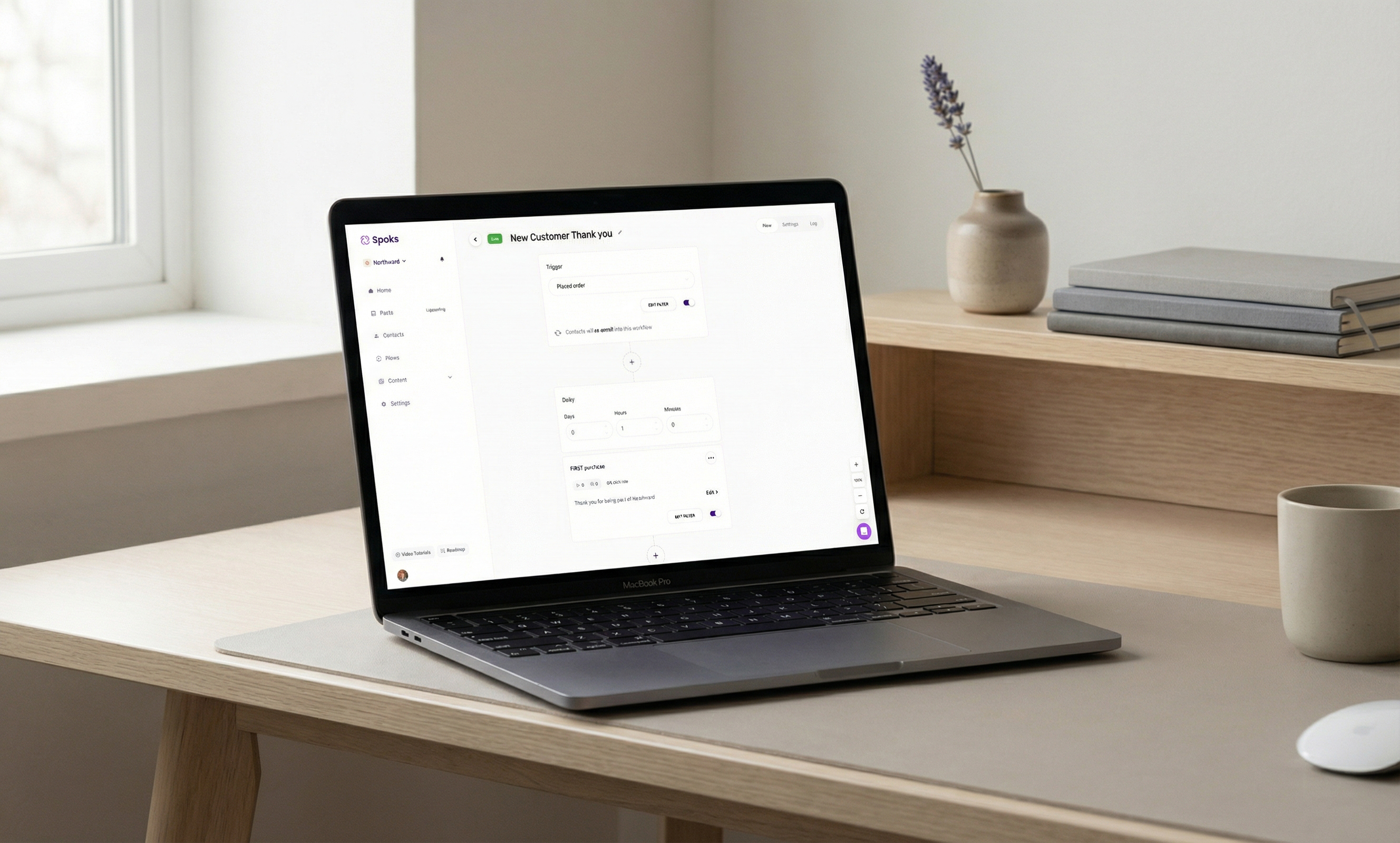
1. Spoks — Best Overall Klaviyo Alternative for Growing Shopify Stores
One-line verdict: Flat $35/month pricing with unlimited contacts makes this the most predictable and affordable option for stores tired of watching their email bill climb.
- Best for: Shopify stores between 1,000 and 50,000 contacts that want powerful automations without per-contact pricing
- Pricing: $35/month flat, unlimited contacts, email + SMS included
- Shopify integration: 5/5
Key strengths:
- Flat pricing that never scales. Whether you have 500 contacts or 50,000, you pay the same $35/month. No surprises, no tiers, no penalty for growing your list. This alone saves most stores hundreds of dollars per year compared to Klaviyo.
- Built specifically for Shopify. Spoks is a Shopify-native app — not a general-purpose ESP with a Shopify plugin bolted on. Product syncing, order tracking, and customer segmentation work out of the box.
- Fast setup, simple interface. Most stores go from installation to their first automated flow in under an hour. The automation builder is opinionated in a good way: it makes common e-commerce flows easy to set up without drowning you in options.
Key limitations:
- Newer platform. Spoks doesn't have the decade-long track record of Klaviyo or Mailchimp. If you need a platform with a massive template library, extensive third-party integrations outside Shopify, or enterprise-level custom reporting, it's not there yet.
- Less advanced segmentation. Spoks covers the segmentation most stores need (purchase behavior, engagement, demographics), but it doesn't match Klaviyo's predictive analytics or deep custom-property segmentation.
Who should switch: Store owners paying $100+/month on Klaviyo who primarily use standard e-commerce flows (abandoned cart, welcome series, post-purchase). If Klaviyo's advanced features aren't part of your daily workflow, Spoks gives you what you need at a fraction of the cost. Compare Spoks vs Klaviyo directly.
2. Omnisend — Best Mid-Range Alternative With Strong SMS
One-line verdict: A well-rounded platform that hits the sweet spot between Klaviyo's power and simpler tools' ease of use, at a noticeably lower price.
- Best for: Stores between 5,000 and 25,000 contacts that want email + SMS without Klaviyo's pricing
- Pricing: Standard from $16/mo (500 contacts), ~$81/mo at 5K contacts, ~$245/mo at 25K
- Shopify integration: 4/5
Key strengths:
- Pre-built automation workflows that cover 90% of e-commerce needs, ready to activate in minutes
- Solid Shopify integration with product picker, order sync, and standard event triggers
- Web push notifications included on all plans — a channel Klaviyo doesn't offer
Key limitations:
- Still uses per-contact pricing. Cheaper than Klaviyo, but your bill still grows with your list. At 25,000 contacts, you're paying ~$245/month on the Standard plan.
- Predictive analytics are limited. You won't get Klaviyo's churn risk scores, predicted lifetime value, or next-order-date triggers.
Who should switch: Stores that want most of what Klaviyo offers at 40-60% lower cost, and don't rely heavily on predictive analytics. Read our full Omnisend vs Klaviyo comparison for a deep dive.
3. Mailchimp — Best for Stores That Need More Than Email
One-line verdict: The 800-pound gorilla of email marketing, now with a rebuilt Shopify integration — but the e-commerce features still lag behind purpose-built tools.
- Best for: Stores that also need landing pages, social posting, and basic CRM in one tool
- Pricing: Free up to 500 contacts, Standard from ~$13/mo
- Shopify integration: 3/5
Key strengths:
- Massive template library and a polished drag-and-drop email builder
- All-in-one marketing hub with landing pages, social media scheduling, basic CRM, and audience insights
- Affordable entry point with a functional free tier
Key limitations:
- Shopify integration has a messy history. Mailchimp and Shopify had a public breakup in 2019 that left the integration dead for years. It's been restored through a third-party connector (and more recently, a rebuilt official integration), but it's still not as deep or reliable as Klaviyo's or Omnisend's native integration. Order syncing can lag, and some advanced triggers aren't available.
- E-commerce automations feel like an afterthought. Mailchimp was built for newsletters and general marketing, not Shopify stores. Abandoned cart flows and post-purchase sequences exist but lack the depth and Shopify-specific polish of dedicated e-commerce platforms.
Who should switch: Stores that need a general marketing platform and treat email as one channel among many. If Shopify-specific automations are critical to your revenue, Mailchimp vs Klaviyo isn't a close fight — but Mailchimp's broader toolset can justify the trade-off for some businesses.
4. Drip — Best for Revenue-Focused E-commerce Stores
One-line verdict: Purpose-built for e-commerce with strong revenue attribution and visual workflow builder, but the price is similar to Klaviyo's.
- Best for: E-commerce stores (not just Shopify) that want deep revenue tracking and visual automation
- Pricing: $39/mo for 2,500 contacts
- Shopify integration: 4/5
Key strengths:
- Revenue attribution is excellent. Every email, automation, and campaign ties directly to revenue, making it easy to see what's working.
- Visual workflow builder is clean and intuitive — arguably more user-friendly than Klaviyo's flow editor
- Multi-channel support across email, on-site, and third-party integrations
Key limitations:
- Pricing is comparable to Klaviyo. At $39/month for just 2,500 contacts, Drip doesn't offer meaningful savings over Klaviyo. By the time you hit 10K+ contacts, the pricing gap narrows further.
- SMS is not native. Drip focuses on email and on-site messaging. If SMS is part of your strategy, you'll need a separate tool or integration.
Who should switch: Store owners who find Klaviyo's interface overwhelming but want similar e-commerce depth. Drip's workflow builder is cleaner and more visual, which makes it easier for small teams. Just don't expect to save money — this is a lateral move on pricing.
5. ActiveCampaign — Best for Complex Automation Beyond E-commerce
One-line verdict: The most powerful automation engine on this list, but the learning curve is steep and it wasn't built specifically for Shopify.
- Best for: Stores with complex sales funnels, multiple customer journeys, or B2B/B2C hybrid models
- Pricing: Starter $15/mo (1K contacts), Plus $49/mo, Pro $79/mo
- Shopify integration: 3/5
Key strengths:
- Automation capabilities are unmatched. If you can imagine a multi-step, multi-condition workflow, ActiveCampaign can build it. Conditional splits, lead scoring, attribution modeling, CRM pipelines — it's incredibly deep.
- CRM built in. Unlike most email platforms, ActiveCampaign includes a sales CRM. Useful if your Shopify store also has a B2B or wholesale component.
- Affordable entry pricing. The Starter plan at $15/month for 1,000 contacts is competitive, though you'll need the Plus or Pro plan for the features that make ActiveCampaign worth choosing.
Key limitations:
- Not built for Shopify. ActiveCampaign's Shopify integration exists, but it's a plugin — not a native, deep integration. You won't get the same product-syncing smoothness or Shopify-specific triggers you'd get from Klaviyo, Omnisend, or Spoks.
- Steep learning curve. The power comes at a cost: this is not a "set up in an afternoon" platform. Budget a week or more to learn the automation builder and CRM features properly.
Who should switch: Stores with complex customer journeys that go beyond standard e-commerce flows. If you need lead scoring, CRM pipelines, and multi-channel automation sequences that span weeks, ActiveCampaign is built for that. But if you just need solid Shopify email + SMS, it's overkill.
6. Brevo (formerly Sendinblue) — Best for High-Volume, Low-Budget Sending
One-line verdict: The only major platform that charges per email sent instead of per contact — a huge advantage if you have a large list but moderate sending frequency.
- Best for: Stores with 10K+ contacts that send 2-4 campaigns per month
- Pricing: Free (300 emails/day), Starter $9/mo for 5K emails/mo
- Shopify integration: 2/5
Key strengths:
- Pay-per-email model is unique. Brevo charges based on emails sent, not contacts stored. If you have 20,000 contacts but only send 10,000 emails per month, you'll pay a fraction of what Klaviyo or Omnisend would charge.
- Affordable transactional email. If you need transactional emails (order confirmations, shipping updates) alongside marketing, Brevo handles both in one platform.
- Built-in CRM and chat. Like ActiveCampaign, Brevo includes CRM features — useful for stores with sales teams.
Key limitations:
- Shopify integration is weak. Brevo's native Shopify integration is limited. The deeper integration runs through PushOwl (now Brevo's Shopify connector), which adds a layer of complexity. You won't get the seamless product-syncing or event-triggered automations that Shopify-native tools provide.
- E-commerce features are secondary. Brevo was built as a general marketing platform. Abandoned cart, browse abandonment, and post-purchase flows exist but feel less polished than what you'd get from e-commerce-focused tools.
Who should switch: Store owners with large lists who don't send high volumes. If you have 25,000 contacts but only send a monthly newsletter and a few automated flows, Brevo's per-email pricing could save you hundreds compared to contact-based platforms. Just be prepared for a less Shopify-native experience.
7. Privy — Best for Pop-Ups, List Building, and Conversion
One-line verdict: Started as a pop-up tool and still does that better than anyone — email and SMS capabilities are functional but limited compared to full ESPs.
- Best for: Stores that need aggressive list building with pop-ups, banners, and on-site displays
- Pricing: Free plan available, paid plans from ~$12-24/mo
- Shopify integration: 4/5
Key strengths:
- Best-in-class pop-ups and on-site displays. Spin-to-win, exit intent, cart saver, welcome discount — Privy's display tools are the most refined on this list. If growing your list is priority #1, Privy excels here.
- Shopify-native. Built in the Shopify ecosystem, so setup is fast and data syncing is reliable.
- Simple pricing tiers. Easy to understand what you're paying for without a spreadsheet.
Key limitations:
- Email and SMS features are basic. Privy's email builder and automation capabilities don't compete with Klaviyo, Omnisend, or even Spoks. You'll outgrow the email side quickly if you have ambitious automation plans.
- Not a full replacement. Most stores use Privy alongside another ESP — for pop-ups and list growth, not as their primary email platform. That means paying for two tools.
Who should switch: Privy isn't really a Klaviyo replacement — it's a Klaviyo companion or a starter tool. Consider it if you're focused on list building and only need basic email follow-ups, or pair it with a simpler ESP for sending.
8. Seguno — Best for Shopify-Native Simplicity
One-line verdict: Built entirely inside Shopify's admin — you never leave your store. Great for simplicity, limited for power users.
- Best for: Shopify store owners who want to manage email marketing without learning a separate platform
- Pricing: Free up to 250 subscribers, $35/mo for 251-2,500 subs, $55/mo for 2,501-5,000
- Shopify integration: 5/5
Key strengths:
- Lives inside Shopify admin. Seguno operates entirely within Shopify's admin panel. No separate login, no separate app. If you live in Shopify, this is the most seamless email experience possible.
- Unlimited email sends. Unlike most platforms that cap sends based on your plan tier, Seguno lets you send unlimited emails on all paid plans.
- Canva integration. Built-in Canva integration for designing email graphics without leaving the platform.
Key limitations:
- Limited automation depth. Seguno covers the basics (welcome, abandoned cart, post-purchase) but can't match the conditional logic, branching, or event triggers of Klaviyo or ActiveCampaign.
- No SMS. Seguno is email only. If you want SMS marketing, you'll need a separate tool.
Who should switch: Solo founders who want the simplest possible email marketing workflow and don't need advanced automations or SMS. Seguno is a good fit if you value the convenience of never leaving Shopify admin and your list is under 5,000 contacts.
9. Shopify Email — Best Free Starting Point
One-line verdict: Built into every Shopify store with a generous free tier — the obvious first step for stores that are brand new to email marketing.
- Best for: New Shopify stores just starting email marketing with no budget for a third-party tool
- Pricing: 10,000 emails free per month, then $1 per 1,000 additional emails
- Shopify integration: 5/5
Key strengths:
- Free and built in. 10,000 emails per month at no cost is a real offer. For a store with a few hundred contacts sending weekly campaigns, that's months of free email marketing.
- Zero setup friction. It's already in your Shopify admin. No app to install, no account to create, no integration to configure.
- Improving rapidly. Shopify has been investing heavily in Shopify Email, adding automation templates, segmentation improvements, and a better template editor throughout 2025 and into 2026.
Key limitations:
- Automations are extremely basic. You get a handful of pre-built flows (welcome, abandoned checkout, first purchase) but no custom automation builder. You can't create multi-step, branching flows.
- No SMS, no advanced segmentation. Shopify Email handles basic email sends. That's it. There's no SMS, no predictive analytics, no deep segmentation beyond basic Shopify customer groups.
Who should switch: Honestly, you don't "switch" to Shopify Email from Klaviyo — you step down to it. It's the right choice for brand-new stores that aren't ready to invest in a dedicated platform, or for stores that send infrequently and just need a way to blast a monthly newsletter. Once email becomes a meaningful revenue channel, you'll outgrow it.
Full Comparison: All 9 Klaviyo Alternatives for Shopify
| Platform | Starting Price | Pricing Model | SMS | Shopify Integration | Automation Depth | Best For |
|---|---|---|---|---|---|---|
| Spoks | $35/mo flat | Flat rate, unlimited contacts | Yes | 5/5 | Good | Stores wanting predictable pricing |
| Omnisend | $16/mo | Per contact | Yes (Pro plan) | 4/5 | Strong | Mid-size stores, 5K-25K contacts |
| Mailchimp | Free / ~$13/mo | Per contact | Yes (add-on) | 3/5 | Moderate | Stores needing all-in-one marketing |
| Drip | $39/mo | Per contact | No | 4/5 | Strong | Revenue-focused e-commerce |
| ActiveCampaign | $15/mo | Per contact | Yes (add-on) | 3/5 | Advanced | Complex automation & CRM needs |
| Brevo | Free / $9/mo | Per email sent | Yes | 2/5 | Moderate | Large lists, low send volume |
| Privy | Free / ~$12/mo | Per contact | Yes | 4/5 | Basic | Pop-ups and list building |
| Seguno | Free / $35/mo | Per subscriber | No | 5/5 | Basic | Shopify-native simplicity |
| Shopify Email | Free | Per email sent | No | 5/5 | Minimal | Brand-new stores, zero budget |
What About Klaviyo Itself?
For reference, Klaviyo starts at $20/month for 500 contacts and scales to ~$100/month at 5,000 contacts, ~$150/month at 10,000, and ~$400/month at 25,000 contacts. SMS adds to the bill. It remains the best choice for data-driven stores with the budget and team to leverage its advanced features — but for most of the 9 alternatives above, the question is whether you actually need that level of power. Read our full Klaviyo review for the detailed breakdown.
How to Migrate From Klaviyo
Switching email platforms sounds daunting, but the process is more straightforward than most store owners expect. Here's the high-level playbook:
1. Export your data from Klaviyo. Download your subscriber lists, segments, and suppression lists as CSV files. Klaviyo makes this easy from their Lists & Segments section. Also document your active flows — take screenshots of each automation's structure, triggers, and timing.
2. Set up your new platform's Shopify integration first. Before importing anything, connect your new tool to your Shopify store. This ensures new customer data, orders, and events start flowing in immediately.
3. Import your subscriber lists. Upload your CSV exports to the new platform. Make sure suppressed/unsubscribed contacts remain suppressed — this is critical for compliance and deliverability.
4. Rebuild your core flows. Start with the flows that drive revenue: abandoned cart, welcome series, and post-purchase. Most platforms on this list have pre-built templates for these, so you're not starting from scratch.
5. Warm up your sending. Don't blast your entire list on day one from a new platform. Start with your most engaged segments and gradually increase volume over 2-3 weeks. This protects your deliverability.
6. Turn off Klaviyo automations. Once your new flows are live and sending, disable the corresponding Klaviyo flows to prevent duplicate messages. Keep your Klaviyo account active (but downgraded to free) for 30 days as a safety net.
Most migrations take 1-2 weeks from start to finish. The platforms that make migration easiest on this list are Omnisend (which has a built-in Klaviyo migration tool), Spoks (which offers hands-on migration support), and Shopify Email (which requires no import since it reads Shopify's native customer data).
FAQ: Klaviyo Alternatives
What is the best alternative to Klaviyo for Shopify?
It depends on what's driving your switch. If pricing is the main issue, Spoks offers the most dramatic savings with flat $35/month pricing regardless of list size. If you want a similar feature set at a lower cost, Omnisend is the closest competitor with 40-60% lower pricing at most contact tiers. If you want absolute simplicity, Shopify Email or Seguno keep everything inside your Shopify admin.
Is Klaviyo overpriced?
Klaviyo isn't overpriced for what it offers — it's one of the most feature-rich email platforms for e-commerce. The problem is that most Shopify stores don't use enough of those features to justify the cost. If you're paying $200/month but only using abandoned cart flows and a monthly newsletter, you're overpaying for your actual usage. The platform is appropriately priced for data-driven teams that leverage predictive analytics, deep segmentation, and complex automation branching.
Can I switch from Klaviyo without losing my subscribers?
Yes. You can export your full subscriber list, segments, and suppression lists from Klaviyo as CSV files and import them into any other platform. Your subscribers, their consent status, and their engagement history (opens, clicks) are portable. What you can't easily transfer are complex automation flows — those need to be rebuilt in your new platform's workflow builder.
Do Klaviyo alternatives have good deliverability?
The major platforms on this list — Omnisend, Mailchimp, Brevo, ActiveCampaign, Spoks — all maintain strong deliverability rates when used properly. Deliverability depends far more on your sending practices (list hygiene, authentication, engagement-based sending) than on which platform you use. That said, Klaviyo's option for dedicated sending IPs on higher plans gives large-volume senders more control — a feature most alternatives don't offer until enterprise tiers.
Is Omnisend better than Klaviyo?
For most Shopify stores under $50K/month in revenue, Omnisend delivers better value. It covers the automation and Shopify integration basics at a meaningfully lower price. Klaviyo pulls ahead for stores that need predictive analytics, advanced segmentation, and the deepest possible Shopify data integration. Read our full Omnisend vs Klaviyo comparison for the detailed breakdown.
What is the cheapest Klaviyo alternative with SMS?
Spoks at $35/month flat with email and SMS included is the cheapest option for stores with more than a few hundred contacts. For very small lists, Omnisend's Standard plan starts at $16/month but SMS requires the Pro plan ($59/month for up to 2,500 contacts). Brevo offers SMS but charges per message on top of your email plan. Shopify Email does not include SMS at all.
Should I use Shopify Email instead of Klaviyo?
Only if you're just getting started and your email needs are basic. Shopify Email is great for sending simple campaigns and has a generous free tier (10,000 emails/month). But it lacks a real automation builder, has no SMS capabilities, and offers minimal segmentation. Think of it as a starter tool — once email becomes a meaningful revenue channel for your store, you'll want a more capable platform.
How much can I save by switching from Klaviyo?
It varies by list size, but the savings can be significant. A store with 10,000 contacts paying $150/month on Klaviyo could switch to Spoks ($35/month) and save $1,380/year, or to Omnisend ($132/month Standard) and save roughly $216/year. At 25,000 contacts, the savings grow: switching from Klaviyo (~$400/month) to Spoks saves $4,380/year. The right comparison depends on which features you actually use and which you can live without.