Abandoned Cart Text Guide: SMS Templates, Timing, and Compliance
A practical guide to the abandoned cart text: a worked 2-message timing sequence, real templates, and the TCPA consent and penalty rules you need to know before you send.

Justin Rondeau · Founding Head of Growth, Spoks
· Updated November 23, 2026
Quick answer
An abandoned cart text works best as two messages: a plain reminder about an hour after the cart is left, then a second message about 24 hours later if the first one didn't convert.
Before either one sends, you need the shopper's prior express written consent to text them, and every message needs a way to opt out.
Still paying Klaviyo's monthly bill?
Spoks runs about 80% cheaper than Klaviyo for the same flows and campaigns.
Table of contents
- This page is about the SMS channel specifically
- Why an abandoned cart text works differently than email
- The consent rule you can't skip
- A simple 2-message abandoned cart SMS sequence
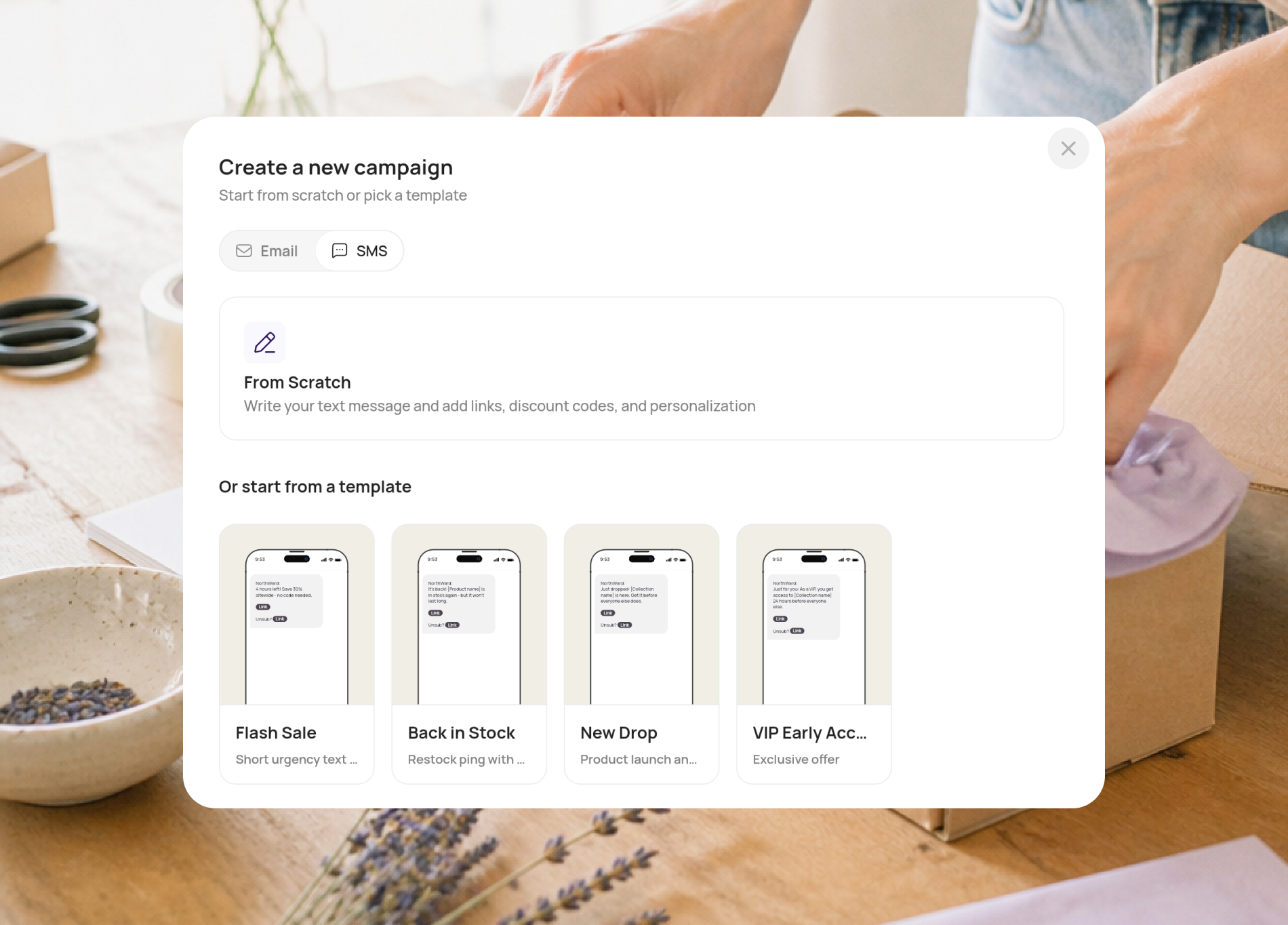
- Abandoned cart SMS templates
- Pairing SMS with the email flow
- Measuring SMS cart recovery performance
- FAQ: Abandoned Cart Text Messages
- Sources
This page is about the SMS channel specifically
Search for "abandoned cart" and most of what comes back is email advice. That's a different flow with different rules. An abandoned cart text message has to earn consent up front in a way email doesn't, it has a hard character budget, and it carries real statutory risk if you get the opt-in wrong. This guide treats SMS as its own channel instead of email's smaller cousin, and it stays narrow: how to get consent right, when to send, and what to actually write.
If you're setting up the email version of this same recovery flow, our abandoned cart email flow guide covers the three-email structure, subject lines, and discount strategy in full. The two channels pair well together, and we'll get to that pairing further down, but they're built and governed differently enough that they deserve separate playbooks.
Why an abandoned cart text works differently than email
A text message lands in the same thread as messages from a shopper's spouse, their kid's school, and their bank. That's exactly why it gets read fast, and exactly why getting SMS marketing wrong costs more than an unsubscribe click. There's no spam folder softening the blow and no sender reputation that recovers over time. Every send either respects the opt-in or it doesn't.
That's the trade-off behind "sms abandoned cart" as a tactic: high attention, low tolerance for mistakes. Get the consent and the frequency right, and it's one of the fastest ways to recover a sale. Get either wrong, and you're not just losing a customer, you're exposed to a specific legal claim with a specific dollar figure attached. That's covered next.
The consent rule you can't skip
Before a Shopify store sends a single marketing text, the shopper needs to have given prior express written consent. That's not a Spoks rule or a best practice someone made up. It comes from the Telephone Consumer Protection Act (TCPA), the federal law the FCC enforces, and it applies to any marketing text sent with automated technology, which covers essentially every cart-recovery platform on the market.
What counts as valid written consent:
- A clear, standalone agreement the shopper actually signs or checks, not something buried inside a store's general terms of service
- States plainly that they're agreeing to receive marketing texts
- Discloses the expected message frequency
- Notes that message and data rates may apply
- The shopper takes an affirmative action, like actively checking a box — a pre-checked box doesn't satisfy this
The checkbox at Shopify checkout, a dedicated SMS popup, or a "text JOIN to..." keyword flow all work, as long as the language is explicit and the shopper takes that affirmative step.
The penalty for getting this wrong is specific, not theoretical. Under the TCPA's private right of action, a consumer can recover $500 in statutory damages for each violating message, and a court can increase that to as much as three times that amount, up to $1,500 per message, if the violation was willful or knowing.1 "Per message" is the part that catches store owners off guard: a single abandoned cart sequence sent to a list of shoppers who never consented isn't one violation, it's one violation per text, per recipient. That math turns a careless SMS blast into real exposure fast.
None of this is specific to abandoned cart flows. It applies to every marketing text a Shopify store sends. But cart recovery is often the first automated SMS flow a store turns on, which makes it the place this rule gets skipped most often, usually by someone who assumes an email opt-in covers texting too. It doesn't. Email and SMS consent are collected and tracked separately.
A simple 2-message abandoned cart SMS sequence
Here's a sensible default timing for an SMS-only cart recovery sequence, built for two messages rather than three or four. SMS earns its place through speed, not repetition, so this sequence stays short on purpose.
| Message | Send time | Job | Discount |
|---|---|---|---|
| 1 | About 1 hour after abandonment | Plain reminder, direct link back to checkout | No |
| 2 | About 24 hours after abandonment | Last nudge, light urgency or a modest one-time offer | Optional |
Message 1, around the one-hour mark. This is the highest-intent window you'll ever have with that shopper. They may have just gotten pulled away by a phone call, a notification, or a kid walking into the room, not necessarily lost interest in the product. Keep the message short: name the item, link straight back to the cart, and skip the discount. A discount this early trains your list to abandon on purpose to get one.
Hey Maria, you left the Canvas Weekender in your cart. Still want it? [link] Reply STOP to unsubscribe.
Message 2, around the 24-hour mark. If the first text didn't convert, something specific is holding the shopper back, usually price, shipping cost, or plain forgetting. This is where a light nudge earns its place, either real urgency (limited stock, a code that expires same-day) or nothing more than a second, friendlier reminder if your margin doesn't support a discount.
Still thinking it over? Your cart's holding for a bit longer. Take 10% off if you check out today: CART10 [link] Reply STOP to unsubscribe.
Two messages, not four. SMS has a lower fatigue threshold than email, both because it's more intrusive and because every text costs you a message credit. If two messages don't recover the sale, a third SMS rarely does either, and it's the kind of over-messaging that pushes opt-out rates up. A store that wants a longer recovery sequence is usually better off layering in email for message three and four rather than adding more texts, which is the pairing covered further down.
See it before you switch
Get Started and your flows import automatically from Klaviyo, no manual rebuild needed.
Abandoned cart SMS templates
A few more templates, organized by the specific situation, since "abandoned cart sms template" searches usually want something to copy and adapt rather than a single example:
Plain reminder (message 1, any cart value):
[Store name]: you left [item] in your cart. Grab it before it's gone: [link] Reply STOP to unsubscribe.
Free shipping as the objection-handler:
Your cart's still here, and shipping's free today. Finish up: [link] Reply STOP to unsubscribe.
Light urgency, no discount (for stores that don't want to train discount-seekers):
[Store name]: your cart expires soon. Don't lose your spot: [link] Reply STOP to unsubscribe.
One-time discount, last touch:
Last call, [first name]. Take 10% off your cart today only: CODE10 [link] Reply STOP to unsubscribe.
Keep every template this plain. A text that reads like an ad, with emojis stacked on exclamation points, tends to get reported as spam faster than a plain one. Every message also needs the opt-out instruction, which most SMS platforms, including Spoks, add automatically so you're not relying on remembering to type it each time.
Pairing SMS with the email flow
Running SMS and email as two unrelated sequences usually means a shopper gets near-identical copy twice, which reads as spammy even when both messages are individually fine. The better setup: let SMS carry the fast, low-detail nudge, and let email carry the detail, the product photo, the reviews, and the actual discount terms.
A common pairing that works: send the SMS at the one-hour mark as covered above, then let the email flow pick up the rest, since our three-email abandoned cart sequence already covers an objection-handling email at 24 hours and a last-call discount email at 48 to 72 hours. Treat the SMS as a faster first touch, not a parallel track with its own full sequence running alongside the emails.
Spoks builds this as one automation rather than two: the flows builder lets you combine triggers, delays, and a mix of email and SMS steps inside a single abandoned cart sequence, so the one-hour text and the 24-hour email live in the same flow instead of two separate tools you have to keep in sync by hand. SMS marketing in Spoks is billed in credits that roll over month to month instead of a fixed bundle that resets each billing cycle, so a quiet month on cart recovery doesn't waste credits you already paid for.2
Measuring SMS cart recovery performance
Track the same thing you'd track for any flow: revenue recovered, attributed to the specific message that drove the order, not just open or click counts. SMS click-through tends to run high because the channel gets seen fast, but a high click rate on a message that doesn't convert is a copy or offer problem, not a timing problem.
Watch the split between message 1 and message 2 specifically. If most of your recovered revenue comes from message 1 alone, the discount in message 2 is likely pure margin loss on orders that would have happened anyway. If message 2 is doing most of the work, your first text's copy or timing probably needs attention before you add a bigger discount at the end.
FAQ: Abandoned Cart Text Messages
How soon should I send an abandoned cart text?
About an hour after the cart is abandoned is a sensible default. That's early enough that the shopper's intent is still warm, but late enough to filter out carts that were always going to convert on their own within a few minutes.
Do I need separate consent for SMS if I already have email opt-in, and what's the risk if I skip it?
Yes, you need separate consent. Email consent and SMS consent are collected and tracked separately under the TCPA, so a shopper who opted into your email list hasn't agreed to receive marketing texts. The risk of skipping it is specific, not abstract: under the TCPA's private right of action, the shopper can recover $500 in statutory damages per violating message, and a court can raise that to as much as $1,500 per message for a willful or knowing violation (see the consent section above for the exact source). That's per message, per recipient, which is why a careless SMS send to an unconsented list can add up fast.
Should the first abandoned cart text include a discount?
No. Lead with a plain reminder. Plenty of abandoned carts recover without any incentive at all, since the shopper often just got interrupted. Save the discount, if you use one, for the second message.
Can I run abandoned cart SMS without an SMS marketing app?
Not realistically for a US Shopify store. Sending at volume requires a registered sending number and automatic opt-out handling, which is what SMS marketing platforms exist to manage. Trying to do it manually through a personal number isn't compliant at scale and won't hold up to the consent and record-keeping requirements covered above.
Does Spoks handle SMS compliance for me?
Spoks adds opt-out instructions to every SMS message automatically, and every link is tracked on your own branded link domain. You're still responsible for collecting and documenting valid consent in the first place, since that part depends on how your store sets up its signup forms and checkout, not on the platform sending the message. For the full rundown on how Spoks' SMS pricing and flow builder work, see Spoks' SMS marketing feature page and its automated flow builder.
Sources
Sources
Footnotes
-
47 U.S.C. § 227(b)(3), the TCPA's private right of action provision, via Cornell Law School's Legal Information Institute (https://www.law.cornell.edu/uscode/text/47/227). The statute provides for $500 in damages per violation, with courts able to increase that award up to three times (to $1,500) for willful or knowing violations. Verified via direct fetch of the U.S. Code text, November 23, 2026. ↩
-
Spoks SMS marketing feature page (
/features/sms-marketing), reflecting the live product's SMS credit pricing, roll-over credits, automatic opt-out handling, and branded link tracking. Verified in-repo, November 23, 2026. ↩