Abandoned Cart Email Guide: The Most Essential Flow for Shopify Stores
A practical abandoned cart email guide for Shopify stores: flow structure, timing, subject lines, discount strategy, and what to measure after you launch it.

Justin Rondeau · Founding Head of Growth, Spoks
· Updated November 16, 2026
Quick answer
A working abandoned cart flow is three emails over three days: a plain reminder (no discount), an objection-handling email at 24 hours, and a last-call email with a one-time discount at 48-72 hours. Treat cart abandonment and checkout abandonment as separate triggers: checkout abandoners are warmer leads.
Still paying Klaviyo's monthly bill?
Spoks runs about 80% cheaper than Klaviyo for the same flows and campaigns.
Table of contents
Flow structure comes before copy
If you run a Shopify store, you already know the feeling: someone adds a $140 jacket to their cart, gets to the shipping step, and vanishes. Don't let that be the end of the story. You need to send recovery emails.
This abandoned cart email guide covers how to build that flow so it earns the sale back: flow structure, timing, what to write, discount strategy, and what to measure once it's live.
Scope comes before tactics. The Baymard Institute runs the most frequently cited cart abandonment benchmark in ecommerce.1 The current average: 70.22% of online shopping carts are abandoned before checkout.
An abandoned cart flow isn't solving for a rare edge case. It's recovering revenue from the single most common outcome at checkout.
A working flow has two separate triggers most store owners lump together as one thing:
- Cart abandonment fires when someone adds a product and leaves without starting checkout. This happens early, and the shopper may not have made a firm decision yet.
- Checkout abandonment fires once someone has entered checkout, sometimes with an email or shipping address already typed in, and leaves before paying. This is a warmer lead. They got further, which usually means something specific stopped them: price, shipping cost, a payment hiccup, or a last-second change of mind.
Treating these as the same audience is why a lot of abandoned cart emails underperform. A browser who added a candle on a whim needs a different nudge than someone who typed their address into checkout and bailed the moment shipping cost showed up.
Timing: when to send each email
| Send time | Goal | Discount | |
|---|---|---|---|
| 1 | Within about an hour | Plain reminder: item, price, direct link back to checkout | No |
| 2 | Around 24 hours later | Address the specific objection (free shipping, reviews, sizing/returns) | No |
| 3 | 48 to 72 hours later | Last call with urgency | Yes, one-time, if margin allows |
| 4 (optional) | Carts above your own value threshold (e.g. $150+) | Extra patience on high-ticket orders | Same as email 3 |
Email 1, within about an hour. This is the highest-leverage send in the whole flow because intent is still warm.
The shopper might have gotten pulled away by a phone call or a notification, not necessarily lost interest. Keep it plain: show the exact item left in the cart, the price, and a direct link back to checkout. No discount yet.
A good chunk of carts recover on this email alone, because nothing was wrong in the first place. The person just got interrupted.
Email 2, around 24 hours later. If email 1 didn't convert, something specific is holding the shopper back.
This is where you address that specific objection instead of repeating the reminder. Lead with free shipping if you have it, add a review or two for the specific product sitting in the cart, or answer whatever objection comes up most at that price point: sizing, return policy, delivery time.
Email 3, roughly 48 to 72 hours later. Last touch.
If your margin allows it, a one-time discount earns its place here, because you've already tried the free nudge and the objection-handling nudge. A discount is the remaining lever.
Pair it with real urgency if you have any, like limited stock or a code that expires in 24 hours. Shoppers can usually tell manufactured urgency apart from the real kind.
Only add a fourth email for carts above a value threshold you set yourself, something like $150 and up, where the extra day of patience on a high-ticket order is worth more than the risk of training that customer to always expect a discount.
Where this starts inside Spoks
Spoks' built-in Abandoned Cart blueprint ships with the first two steps already built, so you're not starting from a blank flow:
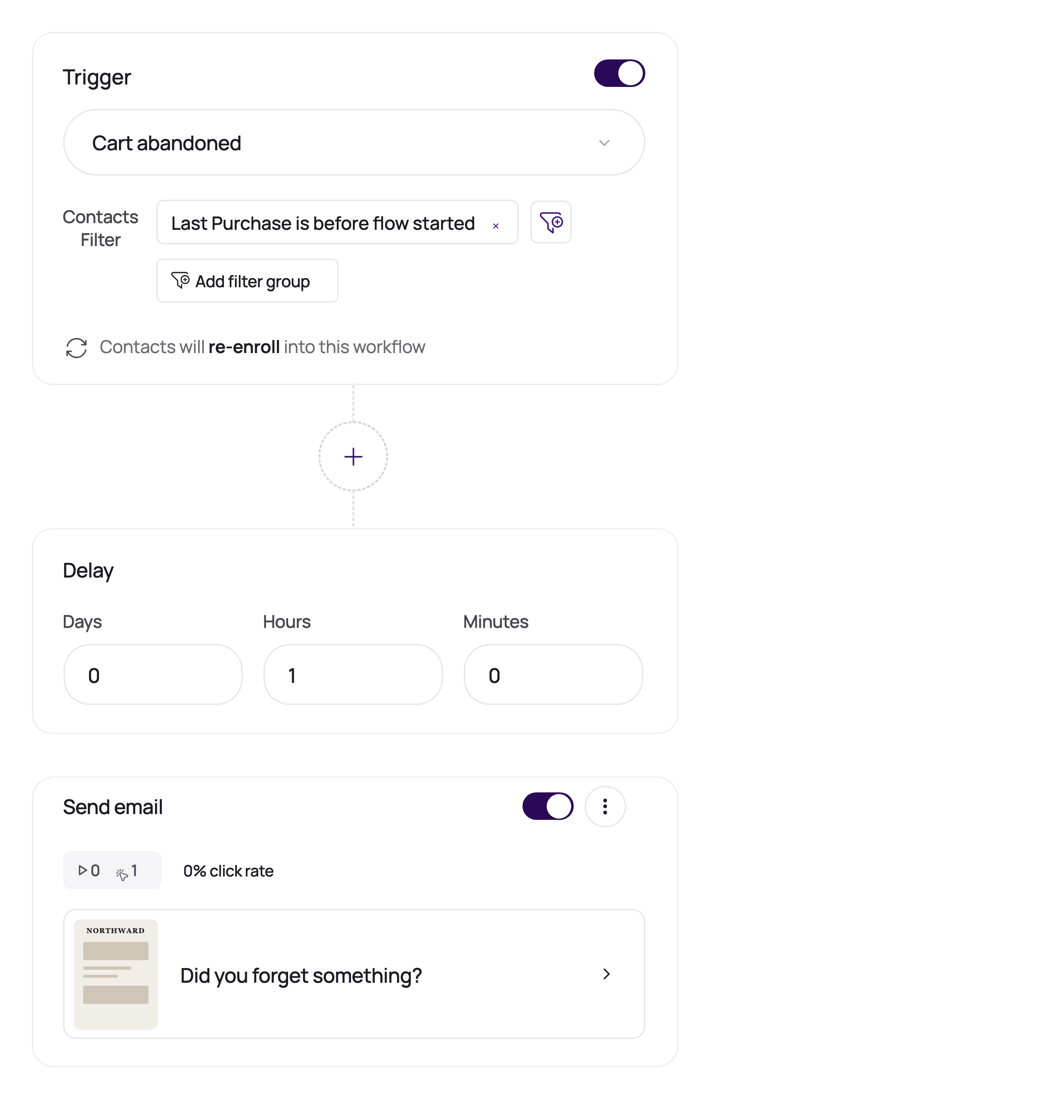
Spoks default, step 1 · sends 1 hour after abandonment
Subject: Did you forget something?
"We've saved the products you added to your cart, so when you're ready you just need to complete your purchase."
Spoks default, step 2 · sends 11 hours after step 1
Subject: Your cart is about to expire
"We've saved the products you added to your cart, so when you're ready you just need to complete your purchase."
The Abandoned Checkout blueprint runs the identical two steps on checkout abandoners specifically, which is why the two triggers covered above stay separate in Spoks' flow list even though they start from the same template.
The objection-handling and discount steps covered next are an upgrade on that starting point, not something that ships by default. Rewrite step 2's subject and copy, then add a third step yourself in the flow builder for the discount email.
What to write in each email
Here's what each of the three emails looks like in a subscriber's inbox, not just described in the abstract.
Email 1 · sent within 1 hour · no discount
Subject: Still want the Canvas Weekender?
Hi Jordan, you left this in your cart. Still want it?
Canvas Weekender ($140)
Finish checkout →
Email 2 · sent at 24 hours · the upgrade on Spoks' default step 2
Subject: Free shipping on your cart, today only
Hi Jordan, your Canvas Weekender is still waiting, and today shipping's on us.
"3,200 people rated this 4.8 stars."
Claim free shipping →
Email 3 · sent at 48-72 hours · one-time discount
Subject: Last call: your cart (and a discount) expire tonight
Hi Jordan, take 10% off before this closes out at 11:59pm tonight.
Code: CART10
Use code & checkout →
For the first email, keep the subject line literal. "Still want the Canvas Weekender?" beats a vague "Don't forget something."
Show the product image, the price, and one button back to checkout, and leave it there. Resist the urge to add a second CTA, a blog link, or a "while you're here" product grid.
The second email is where the harder copywriting happens, because you're now addressing a specific reason someone didn't buy. When you have free shipping to offer, say so directly in the subject line.
If shipping isn't the lever, a short line of social proof does more work than another product shot. It reframes the decision next to the same item from email 1, without discounting anything.
The third email should read like a deadline, because it is one. Put the discount code above the fold, state the expiration time specifically (not "soon," an actual time), and link straight to checkout with the code already applied if your platform supports that.
Every extra click between the email and a completed order is a chance to lose the sale again.
What to avoid across all three: don't reuse the same subject line structure for all three emails. A reader who sees the identical pattern three times in three days starts pattern-matching it as spam before opening.
Too similar (reads as one email repeated three times):
- Email 1: "Still want the Canvas Weekender?"
- Email 2: "Still want the Canvas Weekender? Free shipping today"
- Email 3: "Still want the Canvas Weekender? Last chance"
Varied (reads as three different messages):
- Email 1: "Still want the Canvas Weekender?"
- Email 2: "Free shipping on your cart, today only"
- Email 3: "Last call: your cart (and a discount) expire tonight"
Avoid burying the cart contents in the second or third email under a wall of brand storytelling, either. The shopper already knows your brand. They need to see what they left behind and a reason to go finish it.
See it before you switch
Get Started and copy your flows, templates, and contacts from Klaviyo in minutes.
Discount strategy: when it works and when it backfires
The biggest mistake in abandoned cart flows is opening with a discount. If every shopper learns that abandoning a cart gets them a coupon, you've just taught your entire customer base to abandon on purpose.
Save the discount for the point where you've already tried the free, no-cost nudges: the plain reminder and the objection-handling email.
When you do discount, keep it modest and one-time. The goal is to close out shoppers who were genuinely on the fence, not to compete with your biggest sale event.
A deep, sitewide-sale-level discount in a recovery flow devalues the product for everyone who sees it, including the people who would have bought without one.
A few rules worth setting before you turn the flow on:
- Exclude already-discounted carts. If someone built their cart using a sale-item collection or an existing promo code, don't layer a second discount on top in email 3.
- Tier the discount by cart value instead of using one flat code for everyone. A flat 15% off a $40 cart and a $400 cart isn't the same decision for your margin. Many stores cap the dollar value of the discount rather than leaving the percentage uncapped.
- Set a real expiration and honor it. A code that "expires" and then quietly still works trains customers to ignore your urgency messaging in every future email you send.
Who should never see this flow
Exclusions matter as much as the emails themselves. Stop the flow the instant the cart converts. Nothing erodes trust faster than a "still want to check out?" email landing in someone's inbox after they already paid.
Debounce rapid cart edits, too, so someone adding and removing the same item within a few minutes doesn't retrigger the whole sequence from the top.
And if a shopper already redeemed a different discount in the last 30 days (a win-back offer, a referral code), think twice before stacking another one on top here. It's an easy way to quietly train your best customers into discount-chasers.
High-value carts deserve a different decision entirely. For stores where a single abandoned cart can represent meaningful revenue, some teams route anything above a set threshold to a human follow-up instead of, or alongside, the automated sequence.
An automated flow can't read a hesitant customer's mind. A real person sometimes can.
Measuring what the flow recovers
Open rate and click rate tell you whether the emails are being seen, not whether the flow is making money. The number that matters is recovered revenue: completed orders traced back to a specific step in the flow.
Watch which of the three emails is doing the work. Heavy recovery from email 1 alone means your discount in email 3 might be pure margin loss with no incremental lift, since that order probably would have happened anyway.
When email 3 carries most of the recovery instead, your first two emails may need stronger copy, not a bigger discount at the end.
If you're setting up this flow as part of a larger program, build it alongside the rest of your core email automations rather than in isolation. Our Shopify email marketing guide covers the other flows (welcome, post-purchase, win-back) that round out a full lifecycle program.
Spoks ships separate templates for Abandoned Cart and Abandoned Checkout inside its flow builder, so you can run both triggers without building either from a blank canvas. Layer in delays, filters, and an SMS step for contacts who've also opted into texts.
Every flow step's reported revenue ties back to the order it actually drove, so the recovery number for this flow is directly comparable to any other flow you run.
FAQ: Abandoned Cart Emails
How long should an abandoned cart email flow be?
Three emails over roughly three days covers most stores: an immediate plain reminder, a 24-hour objection-handling email, and a 48-to-72-hour last call with a one-time discount if your margin allows it. A fourth email only makes sense for high-value carts where the extra patience is worth more than the risk of over-messaging.
Should the first abandoned cart email include a discount?
No. Send the plain reminder first, no discount. Plenty of abandoned carts happen because the shopper simply got interrupted, not because of price. Opening with a discount trains your whole list to expect one every time they abandon, which costs you margin on sales you would have made anyway.
What's the difference between abandoned cart and abandoned checkout?
Cart abandonment fires when someone adds a product and leaves without starting checkout. Checkout abandonment fires after someone has already entered checkout, sometimes with an email or address typed in, and left before paying. Checkout abandonment is the warmer lead, and treating both triggers as one audience is a common reason recovery flows underperform.
How many abandoned cart emails is too many?
Beyond three or four in roughly a week, you're more likely to train shoppers to ignore the sequence than to recover the sale. If you notice unsubscribes or spam complaints climbing on this specific flow, that's the signal to cut a step rather than add more urgency to the remaining ones.
Should I pair abandoned cart email with SMS?
It can help, particularly on the first touch, since SMS gets seen faster than email. The two channels work best as a coordinated pair rather than duplicate copy sent twice: let email carry the detail (product image, reviews, discount terms) and use SMS as the quick nudge back to the same cart link.
What's a good abandoned cart recovery rate to aim for?
There isn't a single external benchmark worth chasing here, because recovery rate depends heavily on your price point, traffic quality, and how aggressive your discount strategy is. The more useful comparison is your own flow against itself over time: track recovered revenue by individual email step, and treat quarter-over-quarter improvement in your own numbers as the right target instead of chasing someone else's published average.
Sources
Sources
Footnotes
-
Baymard Institute, "Cart Abandonment Rate Statistics," https://baymard.com/lists/cart-abandonment-rate: "we've calculated the average cart abandonment rate of 70.22%," an average across 50 individual studies. Verified via direct fetch, November 16, 2026. ↩