Email Marketing Benchmarks for Shopify Stores (2026)
Real 2026 email marketing benchmarks for Shopify stores: how much revenue flows generate versus campaigns, and what good conversion rates look like.

David Isak Hansen · Co-founder & CEO, Spoks
· Updated November 16, 2026
Quick answer
Automated flows earn far more per send than one-off campaigns. One 2026 industry benchmark of more than 183,000 Klaviyo customers found flows pull in about 41% of total email revenue from just 5.3% of sends, roughly 12x more revenue per send than campaigns. A separate 2025 dataset found an even wider gap: $3.41 in revenue per automated email against $0.155 per campaign email. If your own flows are earning a smaller share than that, you likely need more of them, not more campaigns.
Still paying Klaviyo's monthly bill?
Spoks runs about 80% cheaper than Klaviyo for the same flows and campaigns.
Table of contents
The gap nobody budgets for: flows vs. campaigns
Most email marketing benchmarks you'll find online are averages pulled from blog posts that cite each other in a circle. The two datasets worth building a strategy around instead come directly from the platforms doing the sending.12 Both point at the same uncomfortable fact: the emails you spend the least time on are earning most of your revenue, and the ones you spend the most time on are earning the least.
One of those reports breaks every send across more than 183,000 Klaviyo customers into two buckets: flows (the automated emails triggered by an action, like an abandoned cart or a welcome series) and campaigns (the one-off blasts a marketer schedules and sends). The split is lopsided in a way that should change how you think about your own send calendar.
Flows account for just 5.3% of total email sends. Campaigns make up the other 94.7%.1 If you judged a store's email program by send volume alone, you'd assume campaigns are where the strategy lives and flows are an afterthought.
Revenue tells the opposite story. That same 5.3% of sends, the flows, brings in roughly 41% of total email revenue.1 Campaigns, despite being nearly 19 out of every 20 emails sent, bring in the remaining 59%.
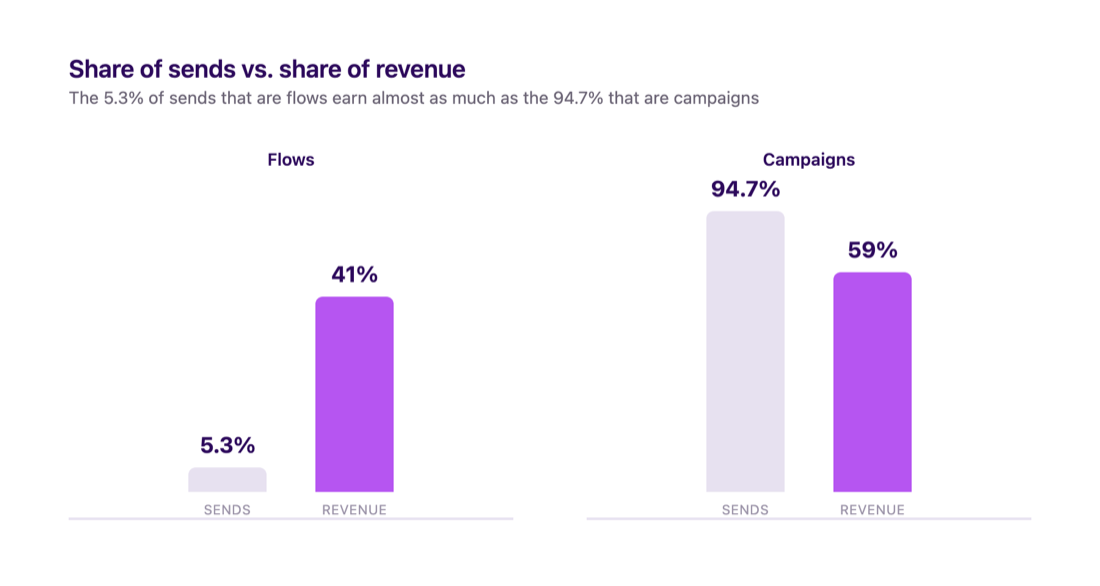
Do the arithmetic on those two percentages and the gap gets sharper: divide each bucket's revenue share by its send share, then compare the two results, and flows come out earning roughly 12 times more revenue per send than campaigns.1 That's our own per-send calculation, not the report's own headline figure. Klaviyo's own page states the gap on a different basis, revenue per recipient, at nearly 18x.1 The two numbers measure different things (a recipient can receive several sends, a send is just one email), which is why they don't match, but either way the direction and the order of magnitude hold. That's not a small edge. That's a different category of email.
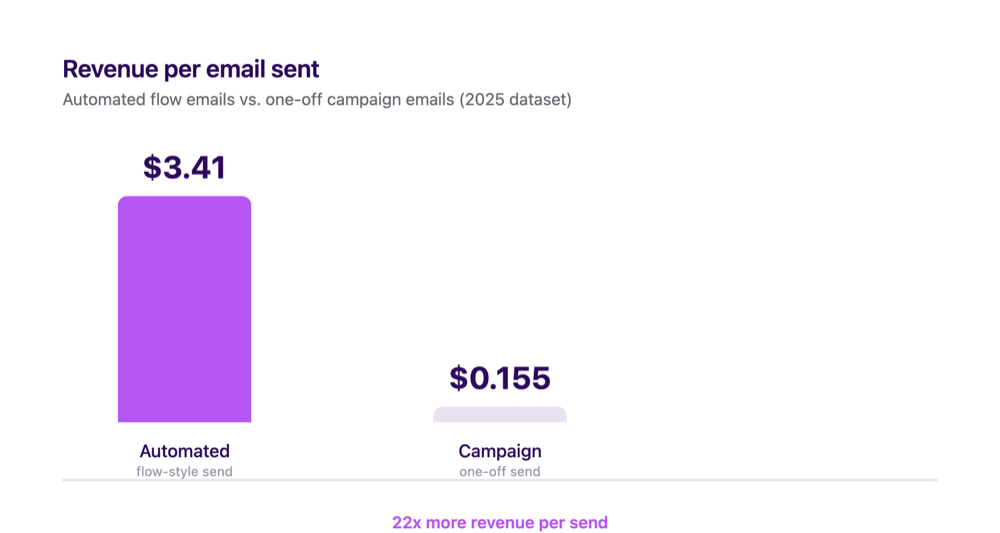
A separate 2025 dataset measures the same divide a different way and lands on an even starker number: $3.41 in revenue for every automated, flow-style email sent, against $0.155 for a one-off campaign email.2 Flows are pulling in roughly 22 times as much per send.
The same pattern shows up in conversions: automated sends closed at 1.49%, campaigns at a fraction of that, 0.08%, putting flows at something like 19 times the conversion rate.2
Two different companies, two different datasets, two different years, and they agree on the shape of the problem even if the exact multiple shifts: automation beats broadcast by an order of magnitude, not a margin.
Why 94.7% of sends still go to the weaker channel
This isn't a case of marketers being lazy or careless. Campaigns exist because stores need to announce a sale, launch a product, or say something timely that a pre-built flow can't anticipate.
A flow is set up once and runs for months; a campaign has to be written every time there's news. That asymmetry in effort is exactly why campaigns dominate send volume even though they underperform on a per-send basis. You can script five flows in an afternoon and they'll run for years, but you can't script "we're live on TikTok Shop this Friday" in advance.
The mistake isn't sending campaigns. It's treating flows as a setup task you finish once and never revisit, while campaigns get all the ongoing attention. Most Shopify stores have a welcome series and an abandoned cart flow and consider the automation box checked.
The data suggests that box is worth checking more carefully: if 5.3% of your sends are already carrying 41% of your revenue, the return on building two or three more flows (back-in-stock, post-purchase, browse abandonment) is almost certainly higher than the return on writing one more newsletter.
What "good" looks like in a benchmark table
Here's both data sets side by side, so you can see where your own numbers should land before you start comparing yourself to anyone.
| Metric | Flows / Automated | Campaigns / One-off | Source |
|---|---|---|---|
| Share of total sends | 5.3% | 94.7% | 2026 benchmark 1 |
| Share of total email revenue | ~41% | ~59% | 2026 benchmark 1 |
| Revenue per email sent | $3.41 | $0.155 | 2025 benchmark 2 |
| Conversion rate | 1.49% | 0.08% | 2025 benchmark 2 |
Read this table as a diagnostic, not a scoreboard. If your flows are earning less than a third of your total email revenue, you likely don't have enough of them running, or the ones you have aren't triggered correctly.
If your campaign conversion rate is sitting well under 0.1%, that's consistent with the benchmark, not a sign something's broken. Campaigns are supposed to convert lower than flows, because they reach people at a random point in their buying cycle instead of at the exact moment they showed intent.
Put real send volume against those percentages and the gap gets easier to picture. A store sending 40,000 total emails a month in roughly that same 94.7/5.3 ratio is sending about 37,880 campaign emails and 2,120 flow emails.
For that 2,120 to generate 41% of total email revenue, as the benchmark suggests, each flow email has to be earning something like 12 times what each campaign email earns, which lines up with the per-send math above.
If your own flow volume is a similar small slice of total sends but the revenue share is closer to 15% or 20%, that's not a sign flows don't work for your store. It's usually a sign one or two of the core flows (often back-in-stock or post-purchase, since they're the ones stores build last) either aren't live yet or aren't catching the traffic they should.
See it before you switch
Get Started and copy your flows, templates, and contacts from Klaviyo in minutes.
Measuring your own flow-vs-campaign split
None of this matters if you can't see your own numbers broken out the same way. Most platforms will show you a single blended open rate or a single revenue total for the month, which hides exactly the split that matters.
You need revenue attributed per send, grouped by whether that send was a flow step or a campaign, not a blended average across both.
Spoks' analytics tracks delivered, opened, clicked, and purchased counts for every campaign and flow step automatically, with no pixel or UTM setup required, so you can pull this exact comparison without exporting anything to a spreadsheet.
The revenue behind each number comes from Spoks' revenue attribution, which ties orders back to the campaign or flow that drove them, so a flow step from three months ago and a campaign from this morning get measured the same way.
Once you can see the split, the next question is simple: what percentage of your total email revenue is coming from the 5.3%-ish slice of sends that are flows? If it's well under the benchmark, that's your highest-leverage fix, not a new campaign idea.
Closing the gap without sending more email
The fix for a weak flow-to-campaign ratio is almost never "send more campaigns." It's building out the flows you're missing and trusting them to run.
Start with the flows that have the clearest trigger and the least ambiguity about what to say: welcome, abandoned cart, post-purchase, back-in-stock, and win-back. Each one fires off a specific, unmistakable signal from the customer, which is exactly why they convert at multiples of a broadcast send: the customer already told you what they want by abandoning a cart or asking to be notified when something restocks.
Our Shopify email marketing guide walks through the timing and copy for each of these flows in detail, including the welcome sequence and the abandoned cart timing windows that tend to convert best.
Once those are live, resist the urge to immediately write more campaigns to fill the gap. Let the flows run for a full sales cycle, pull the revenue-per-send numbers, and compare them against your campaign numbers using the same benchmark table above.
If your flows are landing anywhere near the 41%-from-5.3% split covered above, your email program is doing its job. If campaigns are still carrying more than half your revenue from 90%+ of your sends, that's the gap to close before the next product launch email gets written.
Before building anything new, check whether the flows you already have are actually running. The most common reason a store's flow revenue lags the benchmark isn't a missing flow at all. It's a flow that got built, tested, and then left with its send step turned off, because nobody went back to flip it on after the initial setup.
Most platforms create a new flow in draft, with sends disabled until someone reviews and activates them. That's the right safety default, but it's also the easiest place for a good flow to sit unused for months without anyone noticing. Check activation status before you write a single new email.
FAQ: Email Marketing Benchmarks
What's a good email marketing revenue split between flows and campaigns?
A 2026 benchmark report drawn from over 183,000 Klaviyo customers found flows bring in roughly 41% of total email revenue despite making up only 5.3% of sends. If your flows are earning a meaningfully smaller share than that relative to how few of them you're sending, you likely need more automated flows, not more campaigns.
Why do automated flows convert so much better than campaigns?
Flows trigger off a specific customer action (an abandoned cart, a new signup, a restock request), so the message arrives at the exact moment the customer has already shown intent. A 2025 dataset measured automated emails converting at 1.49% versus 0.08% for one-off campaigns, roughly a 19x gap. Campaigns reach people at a random point in their buying cycle, which is why they'll always convert lower even when they're well written.
Should I stop sending email campaigns if flows perform better?
No. Campaigns still carry roughly 59% of total email revenue in that same benchmark data, because they're the only way to announce something time-sensitive: a sale, a launch, breaking news about your store. Use the benchmark to check whether your flows are fully built out before assuming you need to send more campaigns to grow revenue, not as a reason to cut campaigns altogether.
How many flows should a Shopify store have running?
There's no single published number, but the five that show up across most ecommerce benchmark data as the baseline are welcome, abandoned cart, post-purchase, back-in-stock, and win-back. Each one has an unambiguous trigger. Stores that stop at just welcome and abandoned cart are leaving the highest-converting part of their program half-built.
Do these benchmarks apply to small Shopify stores, or only large ones?
The 183,000+ customer sample behind these figures spans the full range of merchant sizes, and the flow-versus-campaign gap tracks timing more than volume. A flow converts better because it fires at the exact moment a customer showed intent, and that holds true at 500 subscribers or 500,000. Smaller stores may see more month-to-month volatility simply because of smaller sample sizes, but the direction of the gap holds.
Where do these specific numbers come from?
From two platform-published benchmark reports, not third-party estimates or a roundup post restating someone else's numbers. The flow-versus-campaign send and revenue splits (5.3% of sends, ~41% of revenue, 94.7% campaign send share) come from one; the revenue-per-email and conversion-rate figures ($3.41 vs. $0.155, 1.49% vs. 0.08%) come from the other. See the Sources section at the end of this article for the exact reports and what each one measured.
How often should I check my numbers against these benchmarks?
Quarterly is enough for most stores. Flow revenue share moves slowly because it's driven by structural choices (which flows exist, whether they're active, how they're timed), not by any single week's campaign calendar. Checking monthly mostly adds noise from seasonal swings; checking once a year means a flow that silently stopped firing could sit broken for months before anyone notices the revenue gap.
If you're building out your own flows and want the setup details rather than just the benchmark, the Shopify email marketing guide covers the welcome series, abandoned cart timing, and the other core automations referenced above.
Sources
Sources
Footnotes
-
Klaviyo, "2026 Email Marketing Benchmarks by Industry" (klaviyo.com/marketing-resources/email-benchmarks-by-industry), drawn from data across more than 183,000 Klaviyo customers. Figures cited: flows generate ~41% of total email revenue from 5.3% of total sends; campaigns account for 94.7% of send volume; average revenue per recipient for flows is nearly 18x higher than campaigns (a revenue-per-recipient figure, distinct from this article's own derived revenue-per-send calculation). Verified via direct fetch, November 16, 2026. ↩ ↩2 ↩3 ↩4 ↩5 ↩6 ↩7
-
Omnisend, "Email Marketing Benchmarks: What Good Looks Like in 2026" (omnisend.com/blog/email-marketing-benchmarks), published May 12, 2026, covering a 2025 dataset of campaign and automated sends. Figures cited: automated emails earned $3.41 revenue per email sent vs. $0.155 for one-off campaigns (~22x gap); automated emails converted at 1.49% vs. 0.08% for campaigns (~19x gap). Verified via direct fetch, November 16, 2026. ↩ ↩2 ↩3 ↩4 ↩5