Best Time to Send Marketing Emails (2026 Data)
Day-by-day and hour-by-hour data from 26 billion emails: when opens, clicks, and conversions actually peak, and why the best time depends on what you measure.

Justin Rondeau · Founding Head of Growth, Spoks
· Updated November 16, 2026
Quick answer
There's no single best time. It depends what you're optimizing for: Tuesday wins for opens and clicks (31.27% open rate), Friday wins for conversions (0.081%), and Saturday is the one day the data says to avoid.
| Goal | Best day | Best hour |
|---|---|---|
| Opens | Tuesday | 9–11 AM |
| Clicks | Tuesday | 7–8 AM or 4 PM |
| Conversions | Friday | 7 AM–12 PM |
These are global benchmarks from 26 billion emails, test them against your own list before committing a whole calendar to one slot.
Still paying Klaviyo's monthly bill?
Spoks runs about 80% cheaper than Klaviyo for the same flows and campaigns.
Table of contents
The day-of-week numbers
If you've searched for the best time to send marketing emails, you've probably landed on a different "winning" day on every site you open. That's because opens, clicks, and conversions don't move together: a day that wins one often loses another.
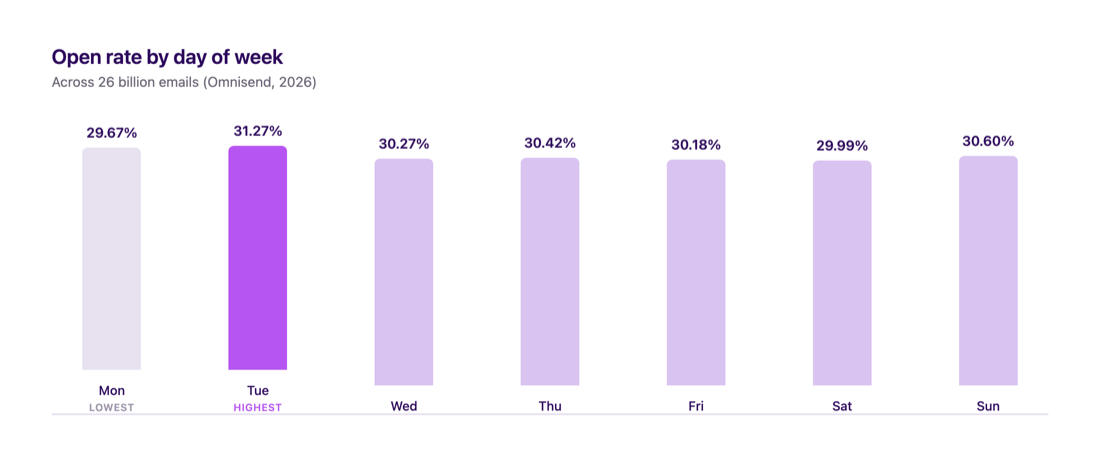
This analysis covers roughly 26 billion emails and breaks out open rate, click-to-sent rate, and conversion rate by day of week.1 Here's the full table:
| Day | Open rate | Click-to-sent rate | Conversion rate | Emails sent |
|---|---|---|---|---|
| Monday | 29.67% | 0.75% | 0.074% | 3.54B |
| Tuesday | 31.27% | 0.81% | 0.078% | 3.80B |
| Wednesday | 30.27% | 0.79% | 0.072% | 3.87B |
| Thursday | 30.42% | 0.78% | 0.075% | 3.96B |
| Friday | 30.18% | 0.77% | 0.081% | 4.51B |
| Saturday | 29.99% | 0.68% | 0.058% | 3.14B |
| Sunday | 30.60% | 0.69% | 0.066% | 3.27B |
A few things worth noticing before you draw any conclusions. Tuesday leads both open rate (31.27%) and click-to-sent rate (0.81%), so if your goal is getting the email seen and clicked, Tuesday is the safer default.
But the gap between the best and worst day for opens is only about 1.6 percentage points. At that scale it's a real difference, just not one that should drive your whole calendar on its own.
Friday tells a different story. Its open rate (30.18%) and click-to-sent rate (0.77%) are both middling, not leading, but it has the highest conversion rate of any day: 0.081%.
People open and click slightly less on Friday, but the ones who do are more likely to actually buy. The data doesn't explain why, and neither will we pretend to. It's consistent enough across the full dataset to be worth testing rather than ignoring.
Friday is also the single highest-volume sending day in the dataset: 4.51 billion emails against a weekly average closer to 3.73 billion.
Worth flagging as a caveat: more marketers already choose to send on Friday, which could mean Friday's conversion lead is partly a self-fulfilling pattern (the businesses with offers worth buying send then) rather than proof that Friday itself makes people more likely to buy.
The data can't separate those two explanations, so don't treat the conversion number as more settled than it is.
Saturday is the day to be cautious with. Click-to-sent rate drops to 0.68%, the weakest showing of the week, and conversion rate falls even further to 0.058%.
Send volume is the lowest of any day too, which tells its own story: fewer marketers even bother sending on Saturday in the first place. If you're going to skip a day for your broadcast calendar, this is the one the data backs you up on.
Why Tuesday wins attention and Friday wins purchases
It's tempting to pick one "winner" and move every campaign to that slot, but opens, clicks, and conversions aren't measuring the same behavior. Opens and clicks measure attention: did the email get noticed, and did something in it look worth tapping.
Conversion measures something further downstream: did that attention turn into money changing hands. That depends on the offer, the product, the price point, and whatever else is competing for that customer's budget that day.
That's the likely reason Tuesday and Friday split the crown instead of one day sweeping all three metrics. A Tuesday send might get read during a workday inbox check, generating a strong open and click, without the recipient being in buying mode yet.
A Friday send might get opened a little less, but it's landing right as people are mentally clearing their to-do list before the weekend and more willing to actually check out. That's a plausible read of the pattern, not a proven mechanism. Treat it as a reason to test Friday sends for anything revenue-focused, not as settled science.
The best hour of the day
Zooming into hour-level data adds a layer the day-of-week table misses. Two patterns hold across most of the week:
- Opens peak between 9 and 11 AM. This is the most reliable window in the entire dataset. If you're picking a single "safe" send hour and don't want to overthink it, this is it.
- Clicks peak twice: 7 to 8 AM, and again around 4 PM. Early risers checking their inbox before the day starts, and a second wave scrolling during the afternoon lull.
One hour stands out from the rest of the dataset entirely: Wednesday at 4 PM posts a 1.08% click-to-sent rate, the highest of any hour, any day, in the whole analysis.1 That's noticeably higher than Wednesday's own day-level average of 0.79%, which is a reminder that day-level benchmarks can hide a much stronger hour buried inside them.
Conversion tells its own story at the hour level too.
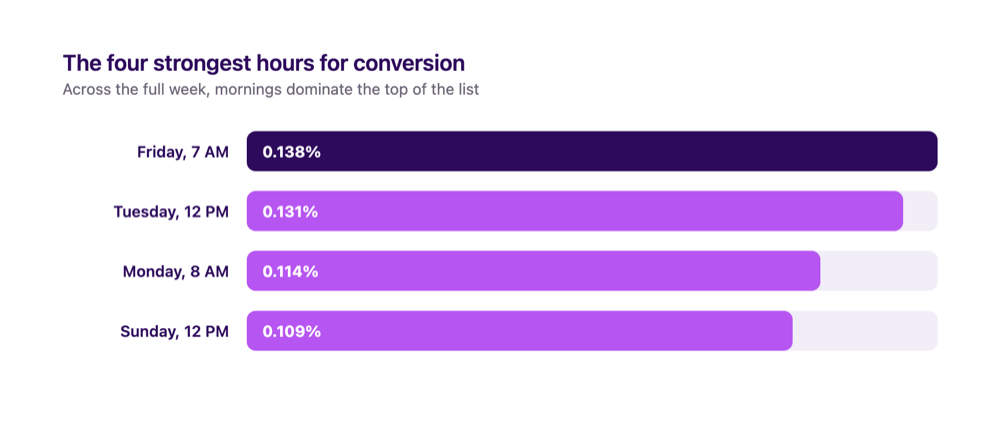
No single hour converts better than Friday at 7 AM, at 0.138%.1 Two others come close: Tuesday at noon (0.131%) and Monday at 8 AM (0.114%).
The pattern across all three is mornings. The best-converting hours cluster early in the day, not in the afternoon click windows.
Here's the best-performing hour per day for each metric, so you can see where your own send times fall relative to the data:
| Day | Best hour for opens | Best hour for clicks | Best hour for conversions |
|---|---|---|---|
| Monday | 1 PM (32.68%) | 4 PM (0.89%) | 8 AM (0.114%) |
| Tuesday | 7 AM (33.41%) | 8 AM (0.94%) | 12 PM (0.131%) |
| Wednesday | 9 AM (32.12%) | 4 PM (1.08%) | 1 PM (0.085%) |
| Thursday | 2 PM (33.06%) | 8 AM (0.87%) | 10 AM (0.093%) |
| Friday | 9 AM (31.92%) | 4 PM (0.94%) | 7 AM (0.138%) |
| Saturday | 9 AM (33.19%) | 6 AM (0.78%) | 8 AM (0.074%) |
| Sunday | 11 AM (33.69%) | 7 AM (0.77%) | 12 PM (0.109%) |
A few of these top conversion figures are close enough to each other (0.138%, 0.131%, 0.114%, 0.109%) that treating the ranking as a precise leaderboard would be reading more certainty into the data than it supports.
The more useful takeaway is the cluster: morning hours, roughly 7 AM to noon, show up repeatedly as the strongest window for turning an email into a sale, across multiple different days.
See it before you switch
Get Started and copy your flows, templates, and contacts from Klaviyo in minutes.
There's no universal best time, and the source data says so itself
It would be easy to end this article with "send Tuesday mornings for clicks and Friday mornings for revenue" and call it done. The source research doesn't make that claim, and neither should this article.
These are global benchmarks across every kind of list, product, and audience mixed together. Your actual customers, their time zone, their shopping habits, and what you're selling will all pull the real answer away from any global average.
The standard recommendation here is to treat these numbers as a starting point, not an answer.1 Look at roughly 10 to 15 of your own past campaigns to spot early patterns in your list's behavior. Then run an actual A/B test across 3 to 5 campaigns where send time is the only thing you change.
It's a small, deliberate test. The result tells you something real about your own list, instead of handing you a guess dressed up as a decision.
Testing this on your own list
The test itself is simple. Pick two send times you want to compare, say Tuesday at 9 AM against Friday at 8 AM, and send the identical email to two randomly split halves of the same segment at those two times. Then look at what actually happened for each half: opens, clicks, and whether the recipients went on to buy.
Here's what a result worth paying attention to might look like, with illustrative numbers from a hypothetical 10,000-contact list split evenly in half:
| Send time | Opens | Clicks | Orders | Revenue |
|---|---|---|---|---|
| Tuesday, 9 AM | 1,620 (32.4%) | 42 (0.84%) | 6 | $780 |
| Friday, 8 AM | 1,480 (29.6%) | 36 (0.72%) | 9 | $1,215 |
Tuesday wins on opens and clicks here, matching the benchmark. But Friday's smaller, more engaged group converted at a higher rate and brought in more revenue, also matching the benchmark's pattern. That result tells you which metric actually matters for this specific email, which is the real point of running the test.
That last part is the one most stores skip, because most platforms only hand you a blended open rate for the month and make you dig for anything tied to revenue.
Spoks' analytics tracks delivered, opened, clicked, and purchased counts for every campaign automatically. A side-by-side send-time test shows up as two rows you can actually compare, rather than a number you have to reconstruct from a spreadsheet export.
Run the same test again on your next campaign before you commit a whole calendar to one time slot. One result could be noise. A result that holds across three or four tests is a pattern worth keeping.
One thing the benchmark data can't account for at all: whose clock it's measuring against. If your Shopify store sells nationally, 9 AM on the East Coast is lunch prep on the West Coast, and still coffee-and-commute time two time zones further out.
These figures don't specify a reference time zone, which means the 9-to-11-AM open window is almost certainly a blend of several local mornings, not one precise clock time.
Before you lock in a send time, decide which time zone you're actually scheduling against:
- Your store's own time zone
- Your biggest customer region's time zone
- A true per-recipient local time, if your platform supports it
That choice moves the target more than shifting an hour on the calendar does.
Automated flows (welcome emails, abandoned cart, back-in-stock) don't follow this same day-of-week logic at all, since they fire off a customer action rather than a scheduled slot. That's a big part of why flows convert so differently from one-off campaigns in the first place.
If you want the fuller picture on how flow timing compares to campaign timing, our email marketing benchmarks piece covers that split in detail.
What this page doesn't cover
This page is about when to send: the day and hour that gets the best response from a list that's already going to open your emails at a normal rate.
It isn't about why your open rate might be low in the first place. That comes down to a different set of factors entirely: sender reputation, list hygiene, and subject line quality chief among them. If your open rates are stuck well below the benchmarks in the tables above no matter what day or hour you send, the fix probably isn't timing. Our companion guide on how to increase email open rates covers that side of the problem.
FAQ: Best Time to Send Marketing Emails
What day gets the most email opens?
Tuesday, at a 31.27% open rate across a dataset of roughly 26 billion sends. The gap to the lowest day (Monday, at 29.67%) is about 1.6 percentage points, which is consistent but not dramatic. Tuesday also leads click-to-sent rate at 0.81%.
What day converts best?
Friday, at a 0.081% day-level conversion rate, the highest of the week despite having a middling open and click rate. At the hour level, Friday at 7 AM is the single strongest hour in the entire dataset for conversions, at 0.138%.
What time of day should I send marketing emails?
It depends on the goal. For opens, 9 to 11 AM is the most consistent window across the week. For clicks, two windows stand out: 7 to 8 AM and around 4 PM, with Wednesday at 4 PM posting the highest click-to-sent rate of any hour measured (1.08%). For conversions, mornings from roughly 7 AM to noon show the strongest results across multiple days.
What's the worst day to send marketing emails?
Saturday. It has the lowest click-to-sent rate (0.68%) and the lowest conversion rate (0.058%) of any day, and the lowest send volume, meaning fewer marketers choose to send that day in the first place.
Should I just move all my campaigns to Tuesday morning?
Not without testing it on your own list first. These are global benchmarks blending every industry, list size, and product type together. The standard guidance is to review roughly 10 to 15 of your past campaigns for early patterns, then A/B test 3 to 5 campaigns where send time is the only variable you change. Your actual best time could match the benchmark, or it could be a different day entirely depending on your customers' habits.
Does send-time data like this apply to automated flows too?
Not really, no. An abandoned cart email or a welcome series fires off a specific action a customer took, not a scheduled slot on the calendar, so day-of-week and hour-of-day benchmarks don't apply to them the same way. If you're trying to improve flow performance, the timing question is about delay after the trigger (say, 30 minutes after cart abandonment) rather than day of week. See our email marketing benchmarks guide for how flow performance compares to campaign performance.
Sources
Sources
Footnotes
-
Omnisend, "The Best Time to Send an Email (2026 Research)" (omnisend.com/blog/best-time-to-send-email), based on an analysis of approximately 26 billion emails. Figures cited: day-level open, click-to-sent, and conversion rates for all seven days; hour-level best-performing slots per day for opens, clicks, and conversions; Wednesday 4 PM as the highest click-to-sent rate of any hour (1.08%); Friday 7 AM as the highest single-hour conversion rate (0.138%); the recommendation to review 10-15 past campaigns and A/B test 3-5 campaigns with send time as the only variable. Verified November 16, 2026. ↩ ↩2 ↩3 ↩4