SMS Marketing Benchmarks for Shopify Stores (2026)
Real 2026 SMS marketing benchmarks for ecommerce: open rate, click-through rate, and conversion rate for campaigns versus automated flows, platform by platform.

David Isak Hansen · Co-founder & CEO, Spoks
· Updated November 18, 2026
Quick answer
SMS (Short Message Service) open rates run close to 98%, well above email, though that's an industry rule of thumb rather than something you can track precisely on your own sends. The real signal is flows versus campaigns: automated flow SMS converts at roughly 2 to 7 times the rate of one-off broadcast sends, and click-through follows the same pattern.
Still paying Klaviyo's monthly bill?
Spoks runs about 80% cheaper than Klaviyo for the same flows and campaigns.
Table of contents
The benchmark numbers, platform by platform
Most SMS marketing benchmarks you'll find online blend several platforms into one headline number without saying which platform backs which figure. This page keeps the real platforms separate, so you can see where the numbers actually come from.
SMS open rate sits close to 98% by most published estimates. There's no way to verify that figure on your own sends, though: most platforms can confirm a text was delivered, not that the recipient actually opened it, so this number is closer to an industry-wide assumption than something your own dashboard will ever show you.1
| Metric | 2026 benchmark, 183,000+ customers 2 | 2026 benchmark, 246M+ sends 2 |
|---|---|---|
| Campaign click-through rate | 5.6% (top 10%: 10.44%) | 12.39% |
| Flow/automated click-through rate | 9.65% (top 10%: 16.6%) | 20.34% |
| Campaign conversion (order) rate | 0.27% (top 10%: 0.61%) | 0.12% |
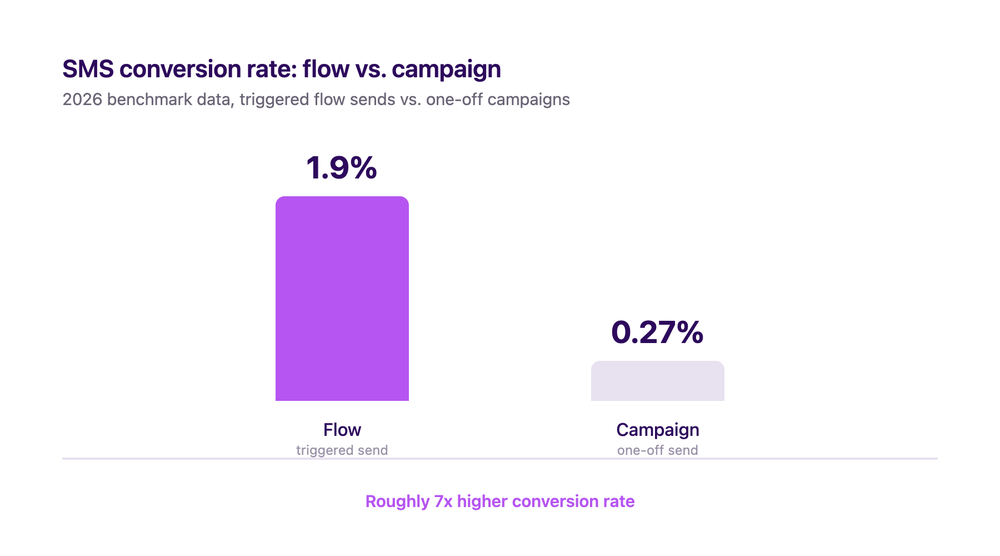
| Flow/automated conversion rate | 1.9% | 0.77-0.78% |
Both platforms agree on the shape even though the exact numbers differ: automated, flow-style SMS converts at roughly 4 to 7 times the rate of a one-off campaign, and click-through follows the same pattern. The gap is smaller than the revenue gap flows show in email (covered in our email marketing benchmarks piece), but it points the same direction.
One real flow example, verified directly: in one 2026 benchmark dataset, Back-in-Stock alerts ranked among the strongest-performing flow type measured, posting a 36-58% click-through rate and converting at 7-13.8%.3
What these numbers actually tell you
A few of these are worth sitting with longer than a glance at the table gives them.
Automated, triggered SMS consistently outperforms one-off campaigns, regardless of whose exact numbers you use. It reaches someone at the exact moment they already showed intent, which is the actual driver behind every number in the table above.
If your SMS program is mostly broadcast campaigns and your conversion rate sits under 0.3%, that's not underperformance. That's roughly what this benchmark data reports as the campaign norm.2 The move isn't to send more broadcasts. It's to build out the automated flows where SMS actually earns its higher click-through and conversion numbers.
Retention matters as much as the open or click number. The same dataset behind the Back-in-Stock figures above shows a median 30-day subscriber retention rate of about 93.1%.3 That's the figure to watch if you want to know whether your SMS program is sustainable, not just whether a single send performed well.
See it before you switch
Get Started and copy your flows, templates, and contacts from Klaviyo in minutes.
How often should you actually send a promotional SMS
There's no single universally-published unsubscribe-rate threshold that every source agrees on, and a couple of the smaller benchmark sites that used to publish one have since taken the page down or gone quiet. Treat any specific number here with some skepticism.
What's better supported: 2 promotional SMS per month is the typical baseline across brands.3 Lists that are already well-segmented and performing well can push that up to 4 to 6 sends a month before retention takes a hit, but that ceiling only holds if the extra volume stays relevant and targeted, not just more frequent.3 The practical signal that matters more than any published threshold is simple: watch your own unsubscribe rate send over send. If it jumps noticeably after a specific send, that send's frequency, timing, or relevance was off, whatever the "normal" rate is supposed to be.
Where Spoks fits
Spoks runs SMS as pay-as-you-go credits rather than a fixed monthly bundle you have to use or lose. Credits roll over instead of expiring, so a slower month doesn't waste what you already paid for.
That matters for benchmarking specifically. If your platform forces you into a set number of credits per month, you're incentivized to hit that number regardless of whether a send is warranted, which is exactly the behavior that erodes retention and pushes unsubscribe rates up over time.
FAQ: SMS Marketing Benchmarks
What's a good SMS open rate?
Around 98% is the commonly cited figure, with most opens happening within minutes of delivery. That's dramatically higher than email's 20-40% open rate, which is the main argument for adding SMS at all. There's a catch, though: SMS platforms can confirm a message was delivered, not that it was actually opened, so nobody can check that 98% figure against their own sends. It's an industry-wide assumption, not a number that will ever show up on your own dashboard.
What's a good SMS click-through rate?
It depends which benchmark you're comparing against. Two large 2026 datasets put campaign click-through rate somewhere between 5.6% and 12.39%, and flow/automated click-through rate between 9.65% and 20.34%. See the platform-by-platform table above for the exact breakdown. Both datasets agree that flows outperform campaigns by roughly double.
What's a good SMS conversion rate?
Again, it varies by platform and send type, roughly 0.12% to 1.9% for general campaigns and flows across two large 2026 datasets (see the table above for the exact breakdown). Specific flow types can run much higher: one verified dataset puts Back-in-Stock messages specifically at 7-13.8% conversion. Compare your own numbers against the platform and send type closest to your situation, not a single blended number.
How many SMS messages per month is too many?
There's no single number every source agrees on, but 2 a month shows up repeatedly as the typical baseline. A well-segmented list that's already performing well can often go up to 4 to 6 a month before it costs you retention, provided those extra sends stay relevant rather than just more frequent. The more reliable signal than any published ceiling is your own unsubscribe rate: watch it send over send, and treat a noticeable jump after a specific send as the real warning sign, not a fixed percentage.
Do these benchmarks apply the same way to SMS flows and SMS campaigns?
No. Flows (welcome, abandoned cart, back-in-stock, win-back) are triggered by a specific action and consistently outperform broadcast campaigns on every platform measured here, because they reach someone at a moment of actual intent. If you're comparing your own numbers against this page, check flow performance against flow benchmarks and campaign performance against campaign benchmarks, not against each other.
Sources
Sources
Footnotes
-
Sender.net (sender.net), "SMS Marketing Open Rate Statistics (2026)," updated March 16, 2026, citing an industry-wide SMS open rate around 98% and noting the figure is "best treated as an industry benchmark rather than a directly trackable metric." Verified via direct fetch, November 18, 2026. ↩
-
Klaviyo (klaviyo.com), 2026 SMS marketing benchmarks drawn from data on over 183,000 Klaviyo customers. Figures cited: campaign click-through rate 5.6% (top 10%: 10.44%), flow click-through rate 9.65% (top 10%: 16.6%), campaign conversion/order rate 0.27% (top 10%: 0.61%), flow conversion rate 1.9%. Cross-referenced with Omnisend (omnisend.com) 2026 SMS marketing statistics, drawn from over 246 million sends: campaign click-through rate 12.39%, automated click-through rate 20.34%, campaign conversion rate 0.12%, automated conversion rate 0.77-0.78%. Both verified via direct fetch, November 18, 2026. ↩ ↩2 ↩3
-
Postscript, "SMS Marketing Benchmarks: What Good Performance Looks Like in 2026" (postscript.io/blog), published January 8, 2026. Figures cited: Back-in-Stock click-through rate 36-58% and conversion rate 7-13.8%; median 30-day subscriber retention rate ~93.1%; typical send frequency ~2 messages/month, with well-segmented high performers sustaining 4-6/month. Verified via direct fetch, November 18, 2026. ↩ ↩2 ↩3 ↩4