Email Marketing ROI: How to Actually Calculate It for Your Shopify Store
A step-by-step guide to calculating email marketing ROI for your Shopify store, with a full worked example you can redo with your own numbers.

Justin Rondeau · Founding Head of Growth, Spoks
· Updated November 23, 2026
Quick answer
Email marketing ROI is revenue attributed to email, minus what you spent running your email program, divided by what you spent. That's it. There's no single multiplier that applies to every store, no matter how often you see one quoted.
Below is the formula worked through with a real Shopify-store example. Redo the same math with your own numbers and you'll have your actual ROI, not someone else's average.
Still paying Klaviyo's monthly bill?
Spoks runs about 80% cheaper than Klaviyo for the same flows and campaigns.
Table of contents
Why there's no single "email marketing ROI" number
Search for "email marketing ROI" and you'll find a single dollar-for-dollar return figure quoted across hundreds of pages, nearly word-for-word. Try to find the actual study behind it and you'll usually hit a dead end.
Why the quoted number doesn't hold up:
- It traces back to a years-old report that nobody seems to have re-run, cited by a blog post, cited by another blog post, cited by this year's "2026 marketing statistics" roundup with the year swapped out and nothing else checked
- We checked the primary sources most often credited for it and couldn't verify the figure on either one; we're not repeating it here
- Your store's actual email revenue depends on your list size, your average order value, how many flows you actually have live, and what you're paying for the platform, none of which a recycled industry number can know
A figure calculated from someone else's store, in a different industry, in a different year, can't tell you anything about your own return. The only number worth trusting is the one you calculate from your own data, using the actual formula below.
The ROI formula
Email Marketing ROI = (Revenue Attributed to Email − Email Program Cost) ÷ Email Program Cost × 100
Three inputs, each with its own wrinkle worth understanding before you calculate anything.
Revenue attributed to email is the total revenue from orders that your platform's attribution ties back to an email send, usually a campaign or a flow step, within some attribution window (most platforms use a last-touch model with a window of a few days). This number comes from your email platform's analytics, not from your total store revenue. Attribution modeling varies between platforms, so don't compare this figure across two different tools without checking how each one counts a "touch."
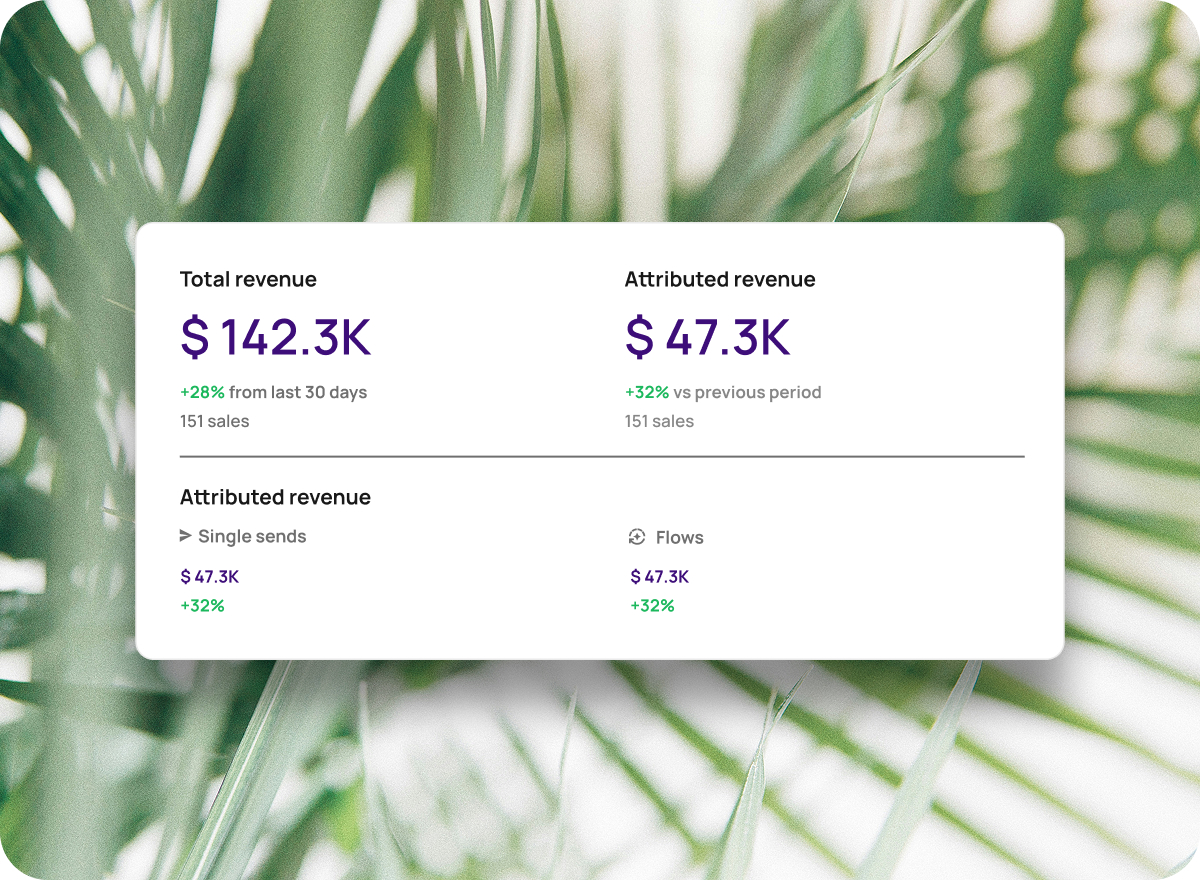
Email program cost is everything you spend to run the channel: your platform's monthly fee, any paid add-ons (deliverability tools, review widgets, copywriting help), and arguably your own time, though most store owners calculate the software cost in isolation since that's the number that's actually controllable month to month. This guide does the same, and flags where labor would change the picture.
The result is expressed as a percentage. A result of 300% means you got back $3 for every $1 spent, on top of recovering the dollar itself. A result of 0% means you broke even. Negative means the channel lost money.
A worked example: 10,000-subscriber Shopify store
Here's the full calculation for a mid-sized Shopify store, step by step, with every assumption labeled so you can swap in your own numbers.
The store: 10,000 email subscribers. Running both one-off campaigns and automated flows.
Steps 1-2: Split monthly sends by type, then price each one using real benchmark data.
Our email marketing benchmarks piece found that, across a large dataset of ecommerce email sends, flows account for just 5.3% of total email sends and campaigns make up the other 94.7%. That same piece cites a separate 2025 Omnisend dataset putting automated flow sends at $3.41 in revenue per email, against $0.155 per one-off campaign email. Applying both to a store sending 40,000 total emails a month:
| Send type | Share of sends | Sends/month | Revenue per send | Revenue |
|---|---|---|---|---|
| Campaigns | 94.7% | 37,880 | $0.155 | $5,871 |
| Flows | 5.3% | 2,120 | $3.41 | $7,229 |
| Total | 100% | 40,000 | $13,100/mo |
This is the step where you should substitute your own platform's revenue-per-send or revenue-per-recipient figures if you have them. The benchmark numbers above are a reasonable stand-in if you don't yet, not a guarantee of what your own store will see.
Step 3: Add up the email program cost, software and labor.
This example runs on Spoks, at $35/month flat. Software alone isn't the full cost of running the program, though: someone has to write and send the campaigns. At a modest 8 hours a week and $30/hour, that's another $960/month. Total program cost: $995/month.
Step 4: Run the formula.
ROI = ($13,100 − $995) ÷ $995 × 100 = ~1,217%
That's the number worth trusting, because it counts what actually running the program costs, not just the software line item. A number calculated on software cost alone would run far higher still, which is a sign you're measuring too narrow a cost, not a sign the channel is unreasonably good. Change the list size, send mix, or either cost input and the percentage moves. That's exactly why a single industry-wide multiplier can't substitute for running your own numbers.
Step 5: Sanity-check the result against your own store.
If your store's email-attributed revenue is far below this example's $13,100/month, check two things before assuming email isn't working: whether your core flows (welcome, abandoned cart, post-purchase, back-in-stock, win-back) are actually live and sending, and whether your attribution window matches how your customers actually buy. A seven-day attribution window undercounts a customer who opens an email on Monday and buys the following weekend.
See it before you switch
Get Started and your flows import automatically from Klaviyo, no manual rebuild needed.
How the result shifts at other list sizes
The 10,000-subscriber example above isn't a universal answer, it's one data point. Running the same formula at a smaller and a larger list, using the same send-mix ratio, the same per-send benchmark figures, and the same $995/month program cost (flat software fee plus the same labor estimate), shows how much the result actually moves and why.
For a 2,500-subscriber store sending 10,000 emails a month in that same 94.7/5.3 split, revenue attributed to email works out to roughly $3,275. For a 50,000-subscriber store sending 200,000 emails a month in the same split, revenue attributed to email comes to roughly $65,500.
| List size | Monthly sends | Revenue attributed to email | Program cost/mo | ROI |
|---|---|---|---|---|
| 2,500 | 10,000 | $3,275 | $995 | ~229% |
| 10,000 | 40,000 | $13,100 | $995 | ~1,217% |
| 50,000 | 200,000 | $65,500 | $995 | ~6,482% |
Because a flat monthly fee doesn't change with list size, the program cost stays fixed across all three rows, and the ROI percentage climbs purely because revenue grows while the denominator doesn't. On a per-contact platform, the cost side would also climb with list size, which is a different shape of result entirely. Larger revenue figures also carry proportionally more assumptions baked into the benchmark-based send-mix math, so treat the 50,000-subscriber row as directional, not a number to plan a budget around.
Where this calculation breaks down
This formula is honest about revenue and software cost, but a few things can throw it off if you're not careful.
Attribution double-counts across channels. If a customer sees a Meta ad, gets a retargeting email, and then buys, some of that revenue might get attributed to both channels depending on how your attribution windows overlap. The ROI formula above measures what your email platform claims, not an airtight incremental-revenue number.
Decide up front whether you're measuring software ROI or total program ROI. The worked example above already folds in a labor estimate for exactly this reason, software cost alone understates what the program actually costs to run. Whichever version you pick, stay consistent about it month to month so your own trend line means something.
One strong month doesn't make a program. A single sale-driven campaign can spike revenue attributed to email for a month without reflecting your program's normal performance. Look at a rolling 3-month average before deciding the ROI formula above represents your typical return.
Growing the list has its own cost, and it's usually not in this formula either. A popup or signup-incentive app, paid ads driving to a landing page, a discount offered in exchange for an email address: all of that is money spent to build the list that's now generating the revenue side of the equation. Most store owners track list-growth spend as a separate line item from the platform bill, which is reasonable, but it's worth knowing it's missing from the number this formula produces.
The lever that's actually in your control: the cost side
Most of the conversation about email marketing ROI focuses on the revenue side: write better subject lines, build more flows, segment harder. All of that matters, but it's also the harder side of the equation to move quickly.
The cost side of the formula is simpler to control, and every dollar cut from the software line goes straight to the ROI side without having to drive more revenue or spend more time on the program. A flat monthly rate that doesn't climb with list size, the way Spoks is priced, keeps that lever available as your store grows, instead of your software cost eating a larger share of revenue the bigger your list gets. Check the pricing page for current numbers before assuming any specific figure, since plans and terms can change.
FAQ: Email Marketing ROI
What counts as "email program cost" in the ROI formula?
Your platform's monthly subscription fee, plus any paid add-ons like deliverability monitoring or review-collection widgets, is the minimum. A more honest number also adds a labor estimate, your own time or a hired marketer's, since someone has to write and send the campaigns. Software cost alone tends to produce an ROI percentage so large it's not useful for decision-making; see the worked example above for how much that changes the result.
How do I find my "revenue attributed to email" number?
Check your email platform's own analytics or reporting dashboard. Most platforms report revenue attributed per campaign and per flow, using a last-touch model within a set window after a send. Add campaign revenue and flow revenue together for the total. If your platform only shows a blended number, you're missing the flow-vs-campaign breakdown that explains most of what's driving (or limiting) your ROI.
Is there a "good" email marketing ROI percentage?
There's no single published standard worth trusting, for the same reason there's no single trustworthy "$X back per $1 spent" stat: it depends on list size, average order value, and how much of your program is cost versus revenue. A more useful benchmark is your own program over time. If this month's ROI is meaningfully lower than your trailing 3-month average, that's worth investigating before you compare yourself to any outside number.
Does switching email platforms actually change my ROI?
It can, but only through the cost side of the formula unless the new platform also changes your actual send performance (deliverability, flow depth, segmentation). A platform with a flat monthly fee instead of a per-contact tier keeps the cost side of the equation predictable as your list grows, which matters more the bigger your list gets. Spoks runs on that flat-fee model.
Can I get help setting this up if I'm not sure where my numbers are coming from?
If you're on Spoks, support is included in the plan and can walk through where your attribution numbers live in the dashboard. If you're evaluating platforms, most offer a sales or support conversation before you commit, which is a reasonable place to ask exactly how their attribution model counts a sale.