SMS Marketing Best Practices for Shopify Stores: A Practical Guide
A practical guide to SMS marketing best practices for Shopify stores: real consent, quiet hours, frequency, and the opt-out mechanics that keep you off a plaintiff's attorney's list.

David Isak Hansen · Co-founder & CEO, Spoks
· Updated November 23, 2026
Quick answer
What actually gets a store sued or burns a list in a week isn't short messages or send-time testing. It's two things: the legal floor every send has to clear, and the frequency discipline that keeps subscribers from hitting STOP. This guide is about those two, not the generic advice that applies to any platform.
For the conversion numbers behind why flows beat one-off blasts, see our SMS marketing benchmarks. For the full setup walkthrough, 10DLC registration, and app comparisons, see our complete Shopify SMS marketing guide.
Still paying Klaviyo's monthly bill?
Spoks runs about 80% cheaper than Klaviyo for the same flows and campaigns.
Table of contents
Get real consent before you send anything
Federal law requires "prior express written consent" before you send marketing texts using an autodialer or a templated send, which covers nearly every SMS marketing tool built for Shopify. That consent has to be a signed agreement (an electronic signature counts) that names the specific phone number, clearly discloses that the signer is agreeing to automated marketing messages, and states plainly that agreeing isn't a condition of buying anything.1 A checkbox the customer actively ticks satisfies this. A pre-checked box doesn't. Burying the disclosure inside a terms-of-service link nobody reads doesn't either.
Shopify's checkout has a native SMS consent checkbox you can turn on under Settings → Checkout → Marketing options, and because it sits in a moment where the customer is already handing over their number, it's usually the single highest-volume opt-in channel a store has. Popups and SMS keywords ("text JOIN to...") work too, but honest checkout consent alone covers most of what a growing list needs.
One best practice worth naming specifically for SMS: ask for consent to text, not consent to be contacted. Email and SMS are two separate permissions under the law. Treating a newsletter signup as blanket permission to text is exactly how stores end up messaging people who never agreed to it.
The real best practice on timing: 8am to 9pm, their time zone
Marketing texts can't go out before 8 a.m. or after 9 p.m. local time at the recipient's location.1 Not your warehouse's time zone, not whatever your SMS app defaults to, theirs. Send a national campaign at 8:30 a.m. Eastern and you've just texted someone in Seattle at 5:30 a.m.
A recent court ruling complicates this, but it shouldn't change what you do:
- A federal court in Delaware ruled this spring that a customer who voluntarily handed over their phone number for marketing may have already taken those messages out of the "telephone solicitation" category the quiet-hours rule covers, meaning real consent could, in theory, make quiet hours not apply at all.2
- That's one district court decision. It isn't binding anywhere else, and it hasn't slowed quiet-hours litigation down: a single plaintiff's firm has filed more than 100 of these suits since late 2024.2
Treat the ruling as background, not a green light. The actual best practice for SMS timing hasn't moved: keep your send window conservative, something like 11 a.m. to 8 p.m. Eastern if you're sending nationally, and let your platform schedule by each recipient's real time zone rather than yours.2
States are tightening this further, too. Oregon extended its telemarketing law to cover text messages in a bill signed into law in 2025 and in effect since January 1, 2026, joining a growing list of states writing SMS-specific restrictions on top of the federal floor.3 If you sell nationally, build to the strictest rule that could apply to any one customer, not the federal minimum.
Build flows before you build campaigns
The single highest-leverage move in Shopify SMS is spending your attention on automated flows before you spend it on broadcast campaigns. A welcome text, an abandoned cart SMS at the 30 to 60 minute mark, a back-in-stock alert, a post-purchase follow-up days later: each one fires because the customer already showed intent, not because it's Tuesday and you have inventory to move. It's also why flow sends convert at several times the rate of a one-off blast, a gap we break down with real flow-versus-campaign conversion numbers.
Build these before a single promotional campaign goes out:
- Welcome / opt-in confirmation, sent within the first minute
- Abandoned cart, first touch at 30 to 60 minutes
- Back-in-stock, for the specific product someone asked about
- Post-purchase follow-up, 5 to 10 days after delivery, not immediately
Campaigns earn a place after those exist, and even then, each one is competing for a limited budget of attention your list gives you.
See it before you switch
Get Started and your flows import automatically from Klaviyo, no manual rebuild needed.
Keep frequency where your list can tolerate it
Published SMS benchmarks converge on a similar range: somewhere around 2 to 6 promotional texts a month is where high-performing stores sit, and past that, unsubscribe rates start climbing fast enough to notice within a single send. Watch your unsubscribe rate on each send rather than a fixed message count. The fix when you see the warning sign isn't a softer subject line. It's cutting frequency and re-segmenting before you send anything else.
| Signal | What it means |
|---|---|
| 2-6 promotional texts a month | Range where most high-performing stores sit |
| Unsubscribe rate above ~1.5% on one send | You sent too often, missed the segment, or both — cut frequency and re-segment before the next send |
| Transactional messages (shipping updates, requested back-in-stock alerts) | Don't count against the promotional budget — customers expect these regardless of hour or frequency |
Make opting out effortless, every time
Every promotional text needs to honor STOP, UNSUBSCRIBE, CANCEL, END, and QUIT immediately, and the FCC expanded that list to also require honoring REVOKE and OPT OUT, effective April 11, 2025.4 You're allowed to name one of those as your "official" opt-out method in your disclosures, but you still have to honor all of them if a subscriber uses a different one. Reply once to confirm the opt-out, then stop sending entirely until they re-subscribe on their own.
| Opt-out keyword | Required since |
|---|---|
| STOP, UNSUBSCRIBE, CANCEL, END, QUIT | Industry baseline (CTIA), already standard before 2025 |
| REVOKE, OPT OUT | FCC order, effective April 11, 2025 |
A newer FCC order released October 1, 2026 tightens this further: it lets a business designate one exclusive revocation method, but only from three FCC-approved options (an automated voice or keypress system, specified reply words, or a published opt-out webpage or phone number), and that method has to be clearly disclosed on every call or text. A revocation of marketing consent now also has to apply across all of a sender's marketing messages, including from affiliated brands, not just the specific campaign someone opted out of.5
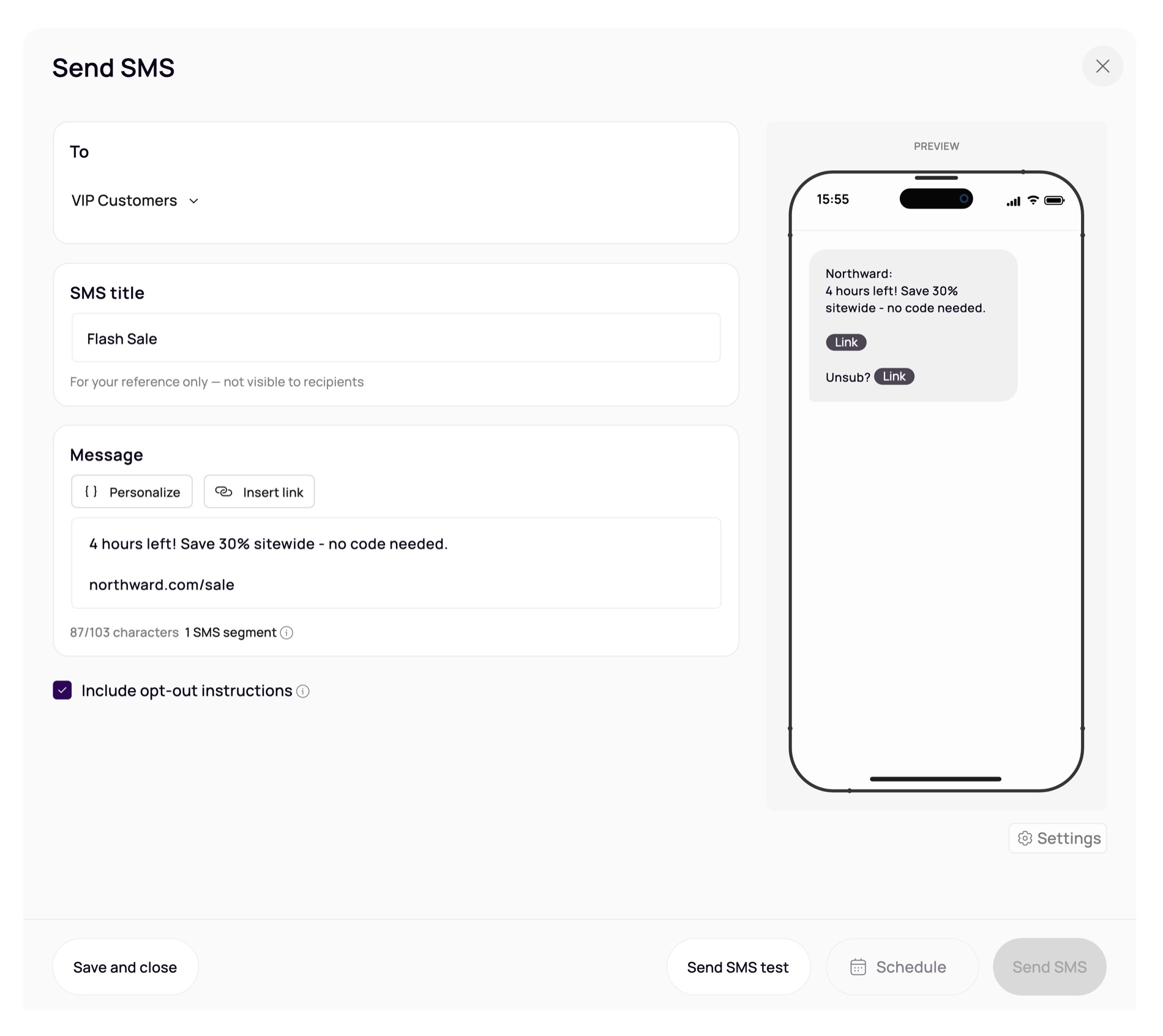
Spoks handles this mechanically rather than leaving it to each merchant to configure correctly: every SMS, whether it's a one-off campaign or a step inside a flow, goes through Spoks' SMS marketing tool with automatic unsubscribe handling and per-recipient link tracking already built in, so a merchant isn't rebuilding opt-out logic by hand for every new send.
Write texts that read like texts
A text that opens like an email subject line ("EXCLUSIVE OFFER INSIDE: Save Big This Weekend Only") reads as spam before the recipient even finishes the first line. The messages that convert read like something a person would actually send: a name if you have one, a specific reason for the text, one link, done. Compare the two:
Weak: "Don't miss our incredible once-in-a-lifetime sale event, happening now for a limited time only! Shop the collection today!"
Better: "Maria, your size just came back in stock. We've got 6 left: [link]"
Keep links trackable and branded where your platform allows it, disclose message frequency and "msg & data rates may apply" in your opt-in language (not in every send), and never make the first text someone gets from you a discount they didn't ask for. The welcome message is the one chance to prove you'll respect the channel before you ask anything of it.
FAQ: SMS Marketing Best Practices
Can I text a customer before 8am if they already opted in?
Legally, it's genuinely unsettled right now. One 2026 court ruling suggests real consent might remove a message from the quiet-hours rule entirely, but that's a single district court decision that other courts aren't bound to follow, and quiet-hours lawsuits haven't slowed down. (More on that ruling in the timing section above.) The practical answer: no, don't. Set a conservative send window (roughly 11 a.m. to 8 p.m. Eastern for national lists) and schedule by each recipient's actual time zone regardless of what any one court has said.
What's the single most common best practice for SMS that stores get wrong?
Treating email consent and SMS consent as the same thing. They're legally distinct, and plenty of stores text people who only ever agreed to a newsletter. The fix is a dedicated SMS opt-in, whether that's Shopify's native checkout checkbox, a popup, or a keyword, that names texting specifically.
How many SMS messages per month is too many?
Above roughly 6 promotional texts a month is where most published benchmarks start seeing real pushback, but the number that actually matters is your unsubscribe rate on each individual send. Above about 1.5% on a send is the signal to cut frequency and re-segment, regardless of what your total monthly count looks like.
What do I do if a customer complains about getting texted too early or too often?
Opt them out immediately, even if they didn't use a STOP keyword, and audit the send that triggered the complaint. If it's one complaint among thousands of recipients, it's probably a one-off. If you're seeing a pattern, your unsubscribe rate on recent sends will usually show the same problem before a second complaint does.
Does Spoks handle TCPA-style compliance automatically?
Spoks builds core mechanics like opt-out handling and per-recipient link tracking into every SMS send, whether it's a campaign or a flow step, so a merchant isn't reinventing that logic. It doesn't replace legal advice specific to your states and your customer footprint. Treat this guide and the product's built-in handling as the floor, and talk to a lawyer who knows your specific business if you're sending at real volume or into multiple states with their own rules.
Sources
Sources
Footnotes
-
47 CFR § 64.1200, via Cornell Law School's Legal Information Institute. Paragraph (c)(1) bars telephone solicitations to residential subscribers "before the hour of 8 a.m. or after 9 p.m. (local time at the called party's location)." Paragraph (f)(9) defines "prior express written consent" as a signed agreement naming the specific phone number and clearly disclosing autodialed/prerecorded marketing use, not conditioned on a purchase. Verified via direct fetch, November 23, 2026. https://www.law.cornell.edu/cfr/text/47/64.1200 ↩ ↩2
-
Nixon Peabody, "A Loud Decision on TCPA Quiet Hours" (May 13, 2026), covering King v. Bon Charge (D. Del., April 30, 2026). The court held that a consumer's voluntary sharing of a phone number for marketing purposes may constitute "prior express invitation or permission" that removes the resulting messages from the TCPA's definition of "telephone solicitation," and therefore from the quiet-hours restriction, while noting this is a single non-binding district court decision amid more than 100 quiet-hours suits filed by one plaintiff's firm since November 2024. The article's own recommendation is a conservative 11 a.m.–8 p.m. Eastern national send window. Verified via direct fetch, November 23, 2026. https://www.nixonpeabody.com/insights/alerts/2026/05/13/a-loud-decision-on-tcpa-quiet-hours ↩ ↩2 ↩3
-
Oregon State Legislature, HB 3865 (2025 Regular Session), signed into law in 2025 as Chapter 580, Oregon Laws 2025, extending the state's telephone solicitation restrictions to cover text messages, with the extension in effect since January 1, 2026. Bill overview verified via search of oregonlegislature.gov and olis.oregonlegislature.gov, cross-referenced against independent reporting; exact final quiet-hours/frequency language in the enrolled text not independently re-verified beyond the scope expansion to text messages. Checked November 23, 2026. https://olis.oregonlegislature.gov/liz/2025R1/Measures/Overview/HB3865 ↩
-
Twilio Changelog, "Opt-Out: Additional Keywords Added Per FCC Ruling" (May 13, 2025), confirming Twilio's default opt-out keyword list (STOP, UNSUBSCRIBE, END, QUIT, STOPALL, CANCEL) was expanded to add REVOKE and OPTOUT/OPT OUT per an FCC rule that took effect April 11, 2025. Verified via direct fetch, November 23, 2026. https://www.twilio.com/en-us/changelog/opt-out-additional-keywords-added-per-fcc-ruling ↩
-
Latham & Watkins, "FCC Revamps Rules on Consent to Calls and Texts Under the TCPA," covering the FCC order released October 1, 2026. The order lets a sender designate one exclusive consent-revocation method from three FCC-approved options (automated voice/keypress, specified reply words, or a published opt-out webpage or phone number), requires clear disclosure of that method on each call or text, and provides that a revocation of marketing consent applies across all marketing messages from that sender, including affiliated entities. Effective 30 days after Federal Register publication, which had not occurred as of the article's publication. Verified via direct fetch, November 23, 2026. https://www.lw.com/en/insights/fcc-revamps-rules-on-consent-to-calls-and-texts-under-the-tcpa ↩